
The Difficult Path of the Harmonic Gear Drive
Happiness lies in life, and life lies in work.
Academician L. A. Zilber
The purpose of these memoirs is to tell about the people who took part in developing a winch with a harmonic gear reducer and hydraulic drive, as well as those who made the organizational decisions. The article includes some technical information, without which the essence of the work done by these organizations and by individual specialists would be lost, as well as personal details directly or indirectly related to this work. I never kept diaries or made notes “for the record.” The only thing that has survived is a phone book with pages yellowed by time, containing the phone numbers and names of colleagues. I ask forgiveness if, in these recollections of events that took place more than 50 years ago, I have possibly omitted something important, described something inaccurately, made an error in a patronymic or surname, or included excessive technical or personal detail.
In July 1986, the final meeting of the Interdepartmental Commission of the USSR Ministry of the Automotive Industry (Minavtoprom) and the USSR Ministry of Defense was held at ZIL. The commission reviewed the results of interdepartmental tests of a winch with a harmonic gear reducer (HGR) and hydraulic drive, mounted on the high-mobility vehicles GAZ-66, ZIL-131, Ural-4320, and KamAZ-4310, conducted under Far North conditions at temperatures of minus 49 to minus 51°C. The tests were carried out under the supervision of a representative of the customer.
The commission was co-chaired by V. K. Koshkin, chief designer of ZIL, representing Minavtoprom, and Colonel A. M. Toporkov, representing the Ministry of Defense. Its members included G. A. Krestovnikov, head of the Department of High-Mobility Vehicles at the Scientific Research Automobile and Automotive Engine Institute (NAMI); V. N. Titov, chief technologist at the Scientific Research Institute of Automotive Industry Technology (NIITavtoprom); representatives of the plants whose vehicles took part in the interdepartmental tests; and representatives of the Ministry of Defense (military acceptance officers). A week before the meeting, commission members received a report on the results of the interdepartmental tests of the new winch, along with ZIL’s reports on bench tests of the harmonic gear reducer (HGR), tests of the winch with the HGR and hydraulic drive on the ZIL-131 vehicle at ZIL’s proving ground in Konakovo, at military units in Kubinka and the 21st Central Scientific Research Testing Institute, in hot desert terrain at ambient temperatures up to plus 39°C, and in the north at temperatures down to minus 33°C.
The commission was also presented with a technical quality-level assessment developed by NAMI and a report by NIITavtoprom on the manufacturability of the design. Commission members had the opportunity to examine the drawings of the winch with the HGR and its installation on the vehicle. It should be noted that the new winch involved not merely replacing the worm-gear reducer with a harmonic gear reducer, but a complete redesign of all its components.
The Interdepartmental Commission resolved: “The winch with the HGR is recommended for production and for equipping the all-wheel-drive vehicles GAZ, ZIL, Ural, and KamAZ (with KrAZ and MAZ to follow later), replacing traction winches with worm-type reducers. In terms of technical level, the winch design is recognized as comparable to the world’s best examples and is assigned to the highest quality category” (Interdepartmental Commission acceptance certificate for prototype winches with HGR and hydraulic drive on ZIL, GAZ, KamAZ, and Ural trucks, No. AI 37.001.522-87).
How It All Began
When I was transferring from the tool shop to the Design and Experimental Engineering Department (UKER) to take up a position as design engineer, a colleague with whom I had worked for eight years in the same crew of tool-and-die fitters told me: “You can work as a designer for twenty years, break nothing, and create nothing new. Stick to small-scale design work and live a quiet life.” As it turned out, my life proved to be anything but quiet.
The idea of applying a harmonic gear reducer in an automobile came to me in the mid-1970s. Of course, the HGR by itself held no practical interest. It had to be adapted to some automotive assembly in order to yield a substantial operational and economic benefit. My first thought was to apply a hydraulically driven HGR in an active semi-trailer. A harmonic gear drive could provide kinematic correspondence between the rotation of the semi-trailer’s wheels and that of the tractor’s wheels, which would substantially improve the vehicle’s off-road mobility. The second option was an automotive traction winch, in which the worm-gear reducer would be replaced by a harmonic gear reducer. In both cases the work came down to the same main goal — creating a simple, heavily loaded HGR with low specific mass, suitable for operation under a range of climatic conditions. Although the first option was more attractive from a prestige standpoint, the decision was made in favor of the winch. Here is why.
Traction winches are fitted to high-mobility vehicles — GAZ, ZIL, KamAZ, Ural, MAZ, KrAZ, and other special-purpose vehicles — since, off-road and in deep snow, the winch is the only means by which a vehicle can overcome an impassable stretch of terrain. ZIL alone produced more than 20,000 winch-equipped vehicles per year. Yet despite the similarity of design (worm-gear reducer and cardan drive), each plant designed and manufactured its own winch independently for its own vehicle, with no unification whatsoever. As preliminary layouts and calculations progressed, the advantages of a winch with a harmonic gear reducer became increasingly clear. To illustrate what is at stake, let us compare a winch with an HGR and hydraulic drive to a winch with a worm-gear reducer and cardan drive.
- Replacing the worm-gear reducer on ZIL vehicles with a harmonic gear reducer reduces the consumption of steel and cast iron, and — especially important — of 16.5 kg (blank weight) of high-tin bronze, an expensive, strategically important material. (The mass of the worm-gear reducer for a winch with a 6-ton pulling force is 91 kg, versus 28 kg for the harmonic gear reducer.)
- A worm (globoid) gear pair can operate properly only with correctly set meshing. Mesh adjustment is done by inspecting the contact pattern and repositioning shim washers. Assembling an HGR requires no such adjustment.
- Installing a winch with a worm-gear reducer on ZIL vehicles requires lengthening the frame side rails. This is done by bolting special extension pieces to the rails. A winch with an HGR and hydraulic motor can be installed without extending the frame rails. This also increases the vehicle’s front overhang angle (approach angle) from 36° to 42°. In addition, given the reduced weight of the winch and its installation without rail extensions, it becomes possible to reduce the number of leaves in the front springs of the ZIL-131, bringing them into line with the springs used on the ZIL-130.
- Because the worm-gear reducer heats up at ambient temperatures above 20°C, the number of continuous full-cable, full-load pulls is limited to 2–2.5. Under Industry Standard OST 001.090-79 (Automotive Winches), the number of such pulls must be at least three. For the winch with a harmonic gear reducer, the number of continuous pulls is not limited by reducer heating. Automotive journalist Leonid Kuznetsov describes the consequences of the worm-gear winch’s inability to function at high altitude: “The problem with the traction winches on all-wheel-drive vehicles reached its peak between 1979 and 1988. Afghanistan. Many perfectly repairable Ural-4320 and KamAZ-4310 vehicles were pushed off cliffs…” (from the website AVTO (AND NOT ONLY).RU, article published November 13, 2013). 5. Using an HGR makes it possible to reduce the mass of the winch’s mechanical drive components, or to use a volumetric hydraulic drive with inexpensive gear pumps and gear motors that do not require finely filtered oil. In addition, the hydraulic drive expands the layout options for mounting the winch on the vehicle. For example, on the KamAZ-4310 the worm-gear winch is located under the vehicle body and is driven by three cardan shafts, with an intermediate cardan shaft mounted on two supports; guide rollers are provided to feed the cable forward along the vehicle frame. A winch with an HGR and hydraulic motor can instead be mounted at the front of the KamAZ-4310, while the cab-tilting function is preserved. The hydraulic drive also makes it possible to fit additional equipment on the vehicle — for example, a small crane in the cargo bed.
- In a worm-gear winch, overload protection is provided by a shear pin located where the cardan shaft joins the reducer. The pin shears when the load exceeds the permissible level. A sudden increase in engine speed that does not produce an increase in cable pulling force can also cause the shear pin to fail. Under real-world conditions, replacing the pin is difficult. In a winch with an HGR and hydraulic drive, overload protection is instead provided by a multiple-action relief valve. 7. During the design of the HGR winch, labor-intensity calculations were carried out, showing that manufacturing labor input would be significantly lower than for the worm-gear winch. This was later confirmed by professional analysis carried out by process engineers at the automotive industry research institute (p. 37).
On the Invention of the Harmonic Gear Drive
On September 20, 1959, a US patent was issued to engineer C. W. Musser for a “Strained Gearing,” filed March 21, 1955. Across 31 pages certified by a patent attorney, the patent presents diagrams of harmonic gear drives, describes in detail the operating principle of harmonic gear meshing, the tooth profiles, the required tolerances and clearances in the mesh; examines designs of flexible gear wheels and methods for deforming them; provides formulas for geometric and strength calculations of the drive’s gears and for efficiency calculations; and presents the results of tests on seven gear reducers.
Beginning in the early 1970s, an ever-growing number of publications on harmonic gear drives began to appear in the technical literature, often exaggerating their merits. Various designs of harmonic gear reducers were presented, including flexible gear wheels shaped as cups of various forms with narrow gear rims. Methods of deforming them were described: with one disk, two disks, three disks, or cams of various profiles. Methods of geometric and strength calculation of the gear mesh were also described, whose drawback was a large number of empirical coefficients specified over wide ranges, leading to a wide scatter of results for identical input data. Naturally, I tried to study everything that had been done.
In designing the winch, difficulties arose in maintaining the proper thermal operating regime of the HGR while keeping its specific mass to a minimum, since the winch had to fit into a niche bounded by the width of the vehicle’s frame side rails. There were difficulties in selecting a material for the flexible gear wheel, given the requirements of large-scale production and chemical-thermal treatment. Difficulties also arose in determining the optimal cam profile and its position relative to the flexible wheel so as to eliminate axial force in the mesh. In my work I also drew on experience gained in designing planetary gear reducers, as well as on my own intuition, checking and rechecking calculations and drawings before releasing them to production.
Substantial help was provided by Anatoly Grigoryevich Bashkov, lead process engineer of the plant’s Technology Department and a specialist in heat treatment of materials, who developed a nitriding process for the flexible gear wheel to the required depth, one that practically eliminated distortion (“warping”) of the part.
Igor Grigoryevich Sharov
The work on the HGR winch was an initiative project — undertaken, so to speak, as an amateur pursuit. It was not called for by any production plan. At the time I was working as a design engineer in the design bureau of the Design and Experimental Engineering Department (UKER), engaged in designing equipment for testing automotive components and parts. Under fairly tight deadlines, I had to develop the designs and working drawings for two large test rigs — one for determining the position of the center of gravity of a vehicle’s sprung mass, and another for determining the vehicle’s moments of inertia about three central axes (Author’s Certificates No. 518665 and No. 734519). This was followed by urgent work designing a rig for accelerated testing of engine accessory drive belts, to evaluate the service life of belts of various designs as a function of transmitted torque, pulley wrap angle, rotational speed, and other factors (Author’s Certificate No. 1027564). Work on the harmonic gear reducer had to be squeezed in between these tasks, mostly in the evenings and on weekends. From time to time, during bench testing, I was assisted by a young specialist, Alexander Ivanovich Revin, who had joined the plant’s test-rig design bureau in 1976 after graduating from the Bauman Moscow Higher Technical School (MVTU).
The head of the design bureau was Igor Grigoryevich Sharov — a talented, creative man and an excellent designer. He invented a machine that assembled bicycle wheels automatically, without human involvement (ZIL manufactured bicycles at the time). He knew mathematics and mechanics well, composed piano études that professionals rated highly, and wrote poetry. He loved and understood nature, and painted quite good landscapes. He was a member of the editorial board of the magazine “Tekhnika Molodyozhi” (Technology for the Young). He had golden hands: he could do a quality apartment renovation, repair a watch, or tune a piano. I remember Igor Grigoryevich with a shock of dark, curly hair, a cigarette butt in his mouth, and a stub of a pencil, working out multi-digit calculations on whatever sheets or scraps of paper came to hand, as he worked on explaining the physical nature of gravitation. The main points of this theory were published in “Tekhnika Molodyozhi.” Igor Grigoryevich and I developed a relationship of mutual trust. He knew I was working on the harmonic gear drive and helped me with advice.
By the end of 1976, the general-arrangement drawings of the winch with the HGR assembled with the hydraulic motor were ready, along with drawings of the HGR itself and its components (Fig. 1), and drawings of the winch installation on the ZIL-131 vehicle. With these drawings in hand, I went for advice on the feasibility of manufacturing a prototype of the new winch at the plant to A. P. Zigel, a highly experienced designer who had developed the engines for ZIL’s top-of-the-line passenger cars and for its trucks, and whom I knew slightly. Alexei Petrovich glanced briefly at the drawings and said: “I won’t look at this, and I won’t discuss it. You see” — he pointed to a small part lying on his desk, something like an engine valve rocker arm — “it’s been almost a year that I’ve been trying to get this part made. Neither the chief engineer nor the plant’s chief technologist will even hear of it. And you want them to take an automotive assembly — a winch that has been manufactured for years using well-established technology — off production and start preparing production for your invention. No, I won’t look at it,” Alexander Petrovich repeated, handing back the drawings rolled up in a tube.
A few days later I approached E. M. Gonikberg, who had developed the design of the power steering unit for the truck, with the same question. After looking over the drawings and asking a couple of questions, Yevgeny Markovich said: “Go see Materov.”
Georgy Alekseyevich Materov
Georgy Alekseyevich Materov was deputy head of the Experimental Shop for road testing of vehicles. He was also responsible for all serious laboratory work carried out in the Experimental and Research Work Building (KEIR). G. A. Materov’s authority rested on comprehensive technical knowledge and absolute dedication to his work. A superb organizer, he did not try to keep everything under his own control but trusted people. At the same time, there was a line that, once crossed, meant losing his trust and his willingness to work together — that line was lying, dishonesty in personal relations, or falsifying a technical report; not errors in a report, most of which he checked and edited himself, but a deliberate skewing of results to fit a desired outcome. After looking over the drawings and listening to my explanations, Georgy Alekseyevich said: “For us to talk seriously about this, you need to build a working full-scale (1:1) model of the harmonic gear reducer. A person becomes an ally once he understands how a mechanism works and can explain it to others. Once there’s a working model of the harmonic gear reducer, we’ll decide how to proceed.” After a short pause, he added: “Replacing the mechanism of a working design with a simpler one that works well is not a simple matter.”
That same day I met with V. A. Zhizhenkov, head of the process engineering group in the KEIR experimental shop. It turned out that Vladimir Alexandrovich already knew about the existence of harmonic gear drives (HGDs). I told him about my meeting with Materov, and at Zhizhenkov’s request I left the drawings with him. We met again a couple of days later. On Vladimir Alexandrovich’s desk lay a copy of Ye. G. Ginzburg’s book “Harmonic Gear Drives.” He laid out his plan of action: “We’ll have the housing, cover, and cam blank for the reducer cast in the plant’s foundry, using the grade of cast iron specified in the drawings. I know the process engineers there — we’re in regular contact. We’ll make the rest of the parts ourselves. I’ve already spoken with the head of the prototype shop and told him Materov is backing this work; he promised to help where he can. The only difficulty is the cam — I’ll think about that. As for the flexible bearing, that’s on you.” I knew that flexible bearings were produced in small quantities by the Moscow Experimental Plant of the All-Union Scientific Research and Design-Technology Institute of the Bearing Industry (VNIPP). For help in obtaining the required bearing, I turned to Doctor of Engineering Sciences and Professor A. N. Spitsyn, head of the Machine Parts Department at the Moscow Institute of Electronic Machine Building (MIEM) and my graduate-studies advisor. Alexander Nikolayevich was also a scientific consultant at VNIPP on high-speed bearings for aviation applications. Through his assistance, ZIL received eight flexible bearings free of charge, on the condition that they would later be returned and that VNIPP would receive a report on the test results. As I recall, that report was in fact delivered to VNIPP.
Bench and Road Tests
Manufacture of the harmonic gear reducer’s parts in the prototype shop proceeded on an occasional basis, as opportunities allowed. Producing the cam profile required a special copy-milling machine, which the shop did not have. V. A. Zhizhenkov proposed an original method of machining the cam on a lathe. I too had to take on some machining and fitting work myself — for example, cutting the splines in the cam and the reducer’s gear coupling on a Lend-Lease universal Pratt & Whitney slotting machine located in the tool shop where I had previously worked. I drilled holes and cut threads in the reducer housing, and statically balanced the cam…
The first harmonic gear reducer was assembled — as I recall — by V. A. Zhizhenkov and me on a Sunday in mid-September 1978. The input shaft turned freely, and the brake worked normally. It was gratifying that everything went together without any fitting “off the drawing board.”
The next day we informed Georgy Alekseyevich Materov that the HGR had been assembled. It turned out he had been keeping track of our work all along. G. A. Materov brought in Yu. A. Zosimov, head of the laboratory for testing vehicle assemblies and components — the largest laboratory in KEIR. Principled, firm, and outwardly composed, Yuri Alexandrovich was an excellent specialist who enjoyed well-earned respect both from KEIR’s management and from the research engineers and workers. It was decided to conduct bench tests of the HGR.
Over the course of several days, the necessary tooling was made and the equipment was reconfigured for these tests. Without going into technical detail, I will simply say that during bench testing of harmonic gear reducers with various cam profiles — including one proposed by MVTU (which turned out not to be the best) — the optimal cam design was determined, and the calculated position of the flexible bearing, which practically eliminated axial forces in the mesh, was refined. The tests ran for 14 hours at the maximum permissible calculated load, corresponding to the winch service life specified by OST 001.090-79 (Fig. 2). The reducer was disassembled afterward, and its parts were found to be in working condition. The bench tests and studies continued, with interruptions, for more than four months. This work was not done blindly or on luck, but according to a program worked out in advance. As a result, we ended up with a proven method for calculating a heavily loaded harmonic gear reducer, and later a computer program, written in Fortran IV, for calculating harmonic gear meshing.
At the same time as the bench tests, work continued on improving the HGR design. We had developed a simple, easy-to-manufacture multi-disk spring-loaded brake, made up of steel disks and disks with a thin layer of friction material, with a combined stack thickness of about 15 mm; release was by forced hydraulic action. We also had drawings with the gear teeth cut directly into the reducer housing cover (using a different grade of cast iron), and drawings of a cam with a flange to keep the flexible bearing’s cage from coming loose, with the bearing secured to the cam by a thin standard spring retaining ring. I consulted A. P. Zigel about introducing these improvements. He said: “At this stage, since the HGR test results are positive, nothing should be touched.”
Applying the HGR also made it possible to improve the winch design itself, and its manufacture was included in KEIR’s experimental design work plan. The new winch eliminated the steel drum-support shaft; the coupling between the drum and the reducer was placed inside the drum; a cable-laying guide was added that applies tension to the cable only while it is being spooled onto the drum, whose surface follows a radius matched to the guide’s action (Author’s Certificate No. 965978).
With positive bench-test results for the HGR in hand, it was decided at a meeting chaired by G. A. Materov to test the assembled winch, complete with HGR, on a vehicle. The winch with the HGR and hydraulic drive was installed on a ZIL-131 (Fig. 3). Monitoring instruments were mounted in the vehicle’s cab (Fig. 4).
At this point research engineer Iosif Vladimirovich Voloshinov became involved in the work. Voloshinov’s role in creating the new winch is hard to overstate. Persistent, technically knowledgeable, and an athlete (he played water polo for the “Torpedo” team) who knew how to build relationships with people, he commanded respect from both engineers and test drivers alike — something especially important when working under the harsh conditions of the Far North.
The first tests of the new winch were conducted at ZIL’s proving ground in Konakovo (near Moscow) in 1981 (Fig. 5). They went successfully. Bringing the cable-laying guide into working position took about two minutes.
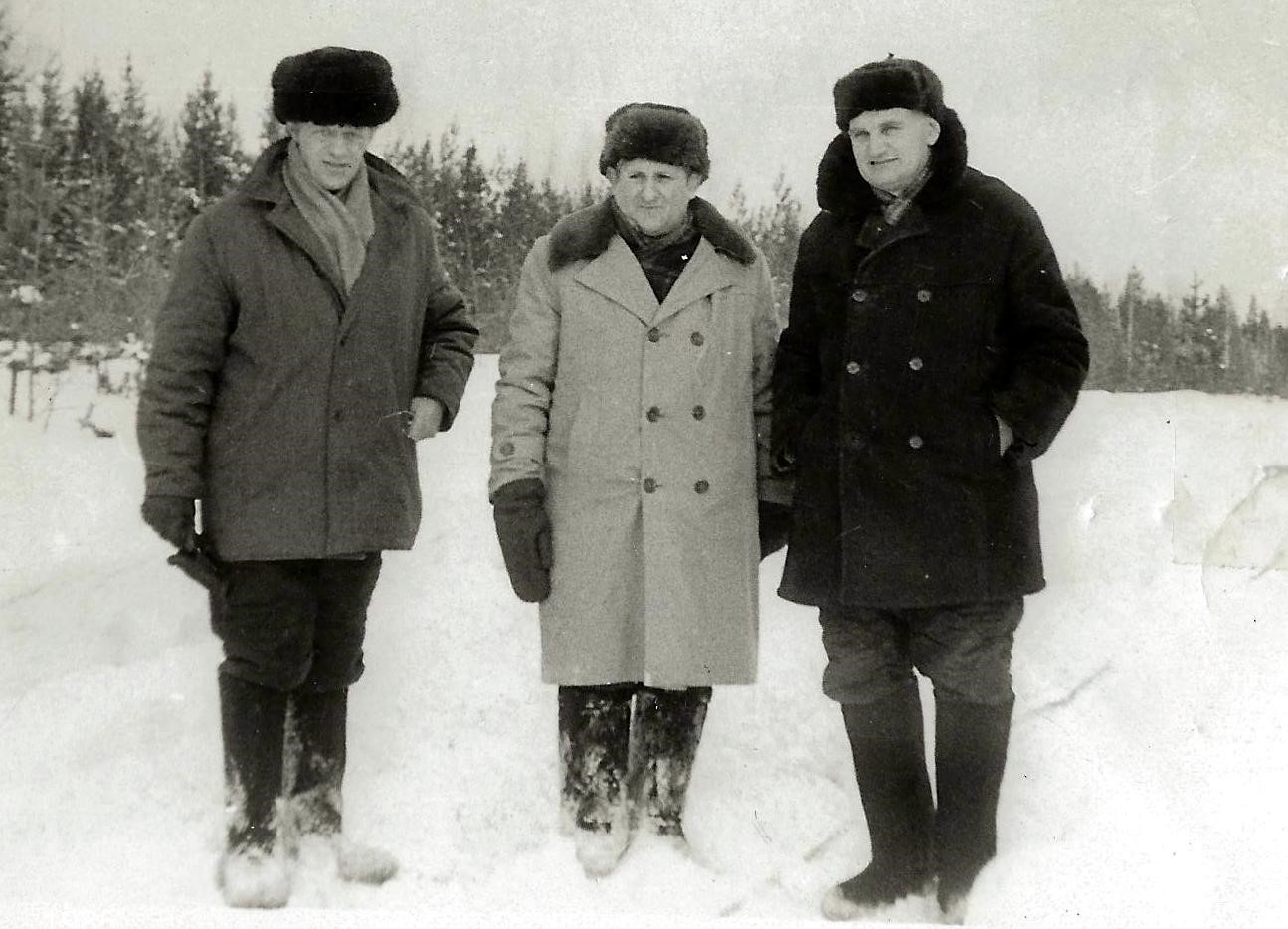
During testing. Left to right: I. V. Voloshinov, S. I. Gorfinkel, Yu. A. Zosimov
At the same time, work was carried out in the power-steering laboratory to refine the pressure setting for the relief valve in the hydraulic system I had designed, which activates when the cable load exceeds the permissible level.
After the Konakovo tests were completed, important tests were carried out in a cold chamber at a military unit. The temperature in the chamber housing the vehicle and winch was lowered to minus 40°C. When the engine was started (it had to be preheated), the temperature “rose” to minus 38°C. The winch with the harmonic gear reducer and hydraulic drive, using winter-grade oil, worked without any problems.
Durability tests were also conducted: in summer, in hot desert terrain at ambient temperatures up to +38°C, and in winter, in the area around the city of Ukhta (Komi). In total, factory testing continued, with interruptions, from 1979 to 1982. I recall with gratitude the KEIR test drivers for their useful practical advice during our work together (Fig. 6).
Based on the results of the factory vehicle tests, G. A. Materov decided to inform the Ministry of the Automotive Industry about the work that had been done — specifically, to inform Ye. A. Bashindzhagyan personally, who oversaw new technology, as well as the plant’s own leadership. I was assigned to meet with Ye. A. Bashindzhagyan and to prepare display boards with the technical and economic figures. I. V. Voloshinov was assigned to prepare an information display stand and a working demonstration unit showing the operation of the harmonic gear mesh.
Meeting with Yevgeny Artemovich Bashindzhagyan
For the meeting with the First Deputy Minister of the USSR Automotive Industry, Ye. A. Bashindzhagyan, G. A. Materov gave me, “just in case,” a document relating to the top-of-the-line ZIL passenger car. I doubted my chances of success, given that, set against the projects Ye. A. Bashindzhagyan was involved with — mastering production of domestic diesel engines, overseeing construction of the Volga Automobile Plant (VAZ), and resolving major industry-wide problems — a winch would hardly seem worth his interest. When I entered his office, Yevgeny Artemovich asked me to wait, picked up the phone, and said: “Car to the entrance.” I understood I had only a few minutes to make my case. I follow a rule: in high-stakes situations, the first two sentences must land hard. Pointing to the drawings, rolled up in a tube, I said: “These are drawings of a new winch design with a harmonic gear reducer for army high-mobility vehicles. The design has successfully passed testing at ZIL.” At the words “harmonic gear reducer,” I sensed that Ye. A. Bashindzhagyan’s interest was piqued. I unrolled the general-arrangement drawing and briefly explained the design. Yevgeny Artemovich asked a couple of questions — the kind of questions an engineer familiar with harmonic drives would ask. In particular, he asked whether the ZIL winch could be applied to other vehicles. I answered yes, and mentioned that this was addressed in the explanatory note. Yevgeny Artemovich asked me to leave the drawings and the explanatory note with him. That short meeting turned out to be of fundamental importance.
A few days later I was summoned to see A. I. Titkov, head of the ministry’s New Technology Directorate, who informed me: “The ministry is allocating funds to test a unified winch with HGR and hydraulic drive, under a single program coordinated with the USSR Ministry of Defense, on high-mobility vehicles produced by the GAZ, ZIL, KamAZ, and Ural plants.”
The organizational side of things at the ministry was handled directly by Ivan Filippovich Buravtsov, whom we met with in his small office. I explained the meaning of the new technical terms. I. F. Buravtsov drafted directives for the automotive industry research institute, NAMI, Bearing Plant No. 23, and the ZIL, GAZ, Ural, and KamAZ plants, covering preparation of the vehicles for testing and the conduct of the tests. ZIL was to manufacture four identical HGR winches. I was assigned to visit the automobile plants to brief them on the new winch’s design and the results of its testing at ZIL.
At this time I. V. Voloshinov arranged for the preparation of informational material, which was set up in the office of the ZIL Production Association’s general director (Fig. 7), where two meetings were held in quick succession: on June 16, 1983, with the plant’s technical service heads led by General Director V. T. Saikin, and on June 18, with Minister V. N. Polyakov and his deputies Ye. A. Bashindzhagyan and A. M. Butusov in attendance. The results of the factory tests were reviewed, along with design, technological, economic, and organizational issues. The minister, in particular, noted the fact that the work had begun as an unofficial, initiative-driven project.
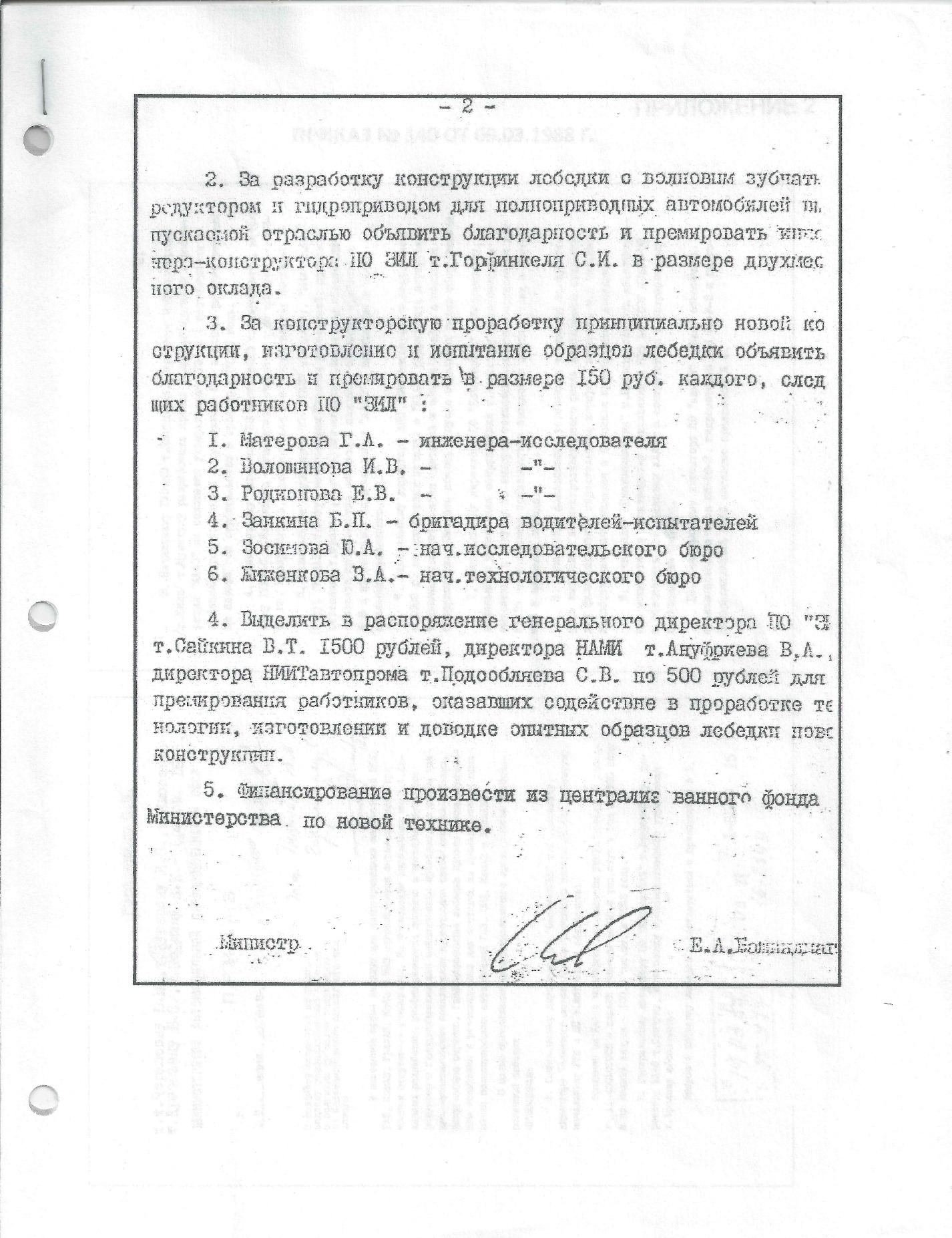
On August 23, 1983, the Minister of the Automotive Industry issued Order No. 441, “On Recognizing Employees of the ZIL Production Association for Creating a New Winch Design” (Appendix No. 1).
Work of Industry-Wide Significance
In accordance with the ministry’s instructions, I. V. Voloshinov and I visited the Gorky Automobile Plant (GAZ), where we met with the chief designer and the engineers who had designed its winch. We also visited the Bryansk Automobile Plant (BAZ) in the city of Bryansk, which manufactured production winches for ZIL. Yu. A. Zosimov and I made two trips to KamAZ in the city of Naberezhnye Chelny. There we met with the deputy chief designer and head of the design bureau, A. I. Kozodaev (Kozodaev had done his practical training at ZIL, in Yu. A. Zosimov’s laboratory). Kozodaev later oversaw the installation of the HGR winch with hydraulic drive at the front of the frame on the KamAZ-4310 (Fig. 8).
I remember our presentation at a military research institute particularly well. The large hall was full of officers. The talk, as I sensed it, went well; we could feel the audience’s attention and interest. Afterward we answered questions from specialists in the audience.
It should be noted that plant leadership raised no fundamental objections to adopting the HGR, subject to one condition: that the harmonic gear reducer and winch be manufactured at a specialized plant. Occasionally, doubts were expressed about the reliability of the harmonic gear drive. As evidence of its high reliability, we would cite its use on the Moon, in the wheel drives of the lunar rovers used on the Apollo 15 and Apollo 16 missions.
On February 9, 1985, the first meeting of the Interdepartmental Commission was held at ZIL. Commission members were shown the GAZ-66, ZIL-131, KamAZ-4310, and Ural-4320 vehicles. After the HGR winches installed on them were checked, testing began. Particular attention was given to testing in the North. The vehicles were shipped to the Vorkuta area by rail, under military escort, in early December 1985, when air temperatures reach their minimum. Credit is due to I. V. Voloshinov, who not only took an active part in these tests but also provided the participants with cold-weather clothing suited to the northern climate, as well as an emergency food supply. All tests were conducted under the direct supervision of representatives of the customer (military acceptance officers).
In accordance with the Interdepartmental Commission’s decision, the ministry instructed NIITavtoprom to develop production technology for the winches, with a planned output of 80,000 winches per year. I had to meet repeatedly with the institute’s process engineers to resolve technological issues requiring changes to the drawings. In most cases we were able to find mutually acceptable solutions.
Work was also carried out jointly with NAMI. Together with G. A. Krestovnikov, head of the Department of High-Mobility Vehicles, an industry standard (OST) for the HGR winch was developed, and the operating instructions for the hydraulically driven winch were refined. NAMI also developed a technical-level and quality assessment card. For comparison, automotive winches from the well-known West German firms ROTZLER and ITAG were used as benchmarks. At the NAMI proving ground, tests were conducted involving pulling a vehicle up a slope and submerging the winch in water (Fig. 9).
In 1983, development was completed of HGR winches with hydraulic and cardan drive and a 12-ton pulling force, for the KrAZ and BAZ vehicles (Fig. 11). (The winch design, with its multiple-action overload protection device, is shown in Figure 11.)
The 12-ton HGR winch differs from the 6-ton version as follows: the gear ratio was changed and the tooth module of the gears was increased; ribs were added to the reducer housing and the lubrication system was modified, allowing the reducer to maintain an acceptable thermal operating regime at ambient temperatures up to +40°C. The winch drum is mounted on spherical bearings. Geometric and strength calculations for the harmonic gear reducer were carried out using the methodology previously developed at ZIL. In the cardan-driven winch, an audible alarm was provided in the driver’s cab to warn of excessive cable load and of the cable reaching full payout, since on the KrAZ the winch is located beneath the vehicle body.
Ten-hour durability tests of the HGR and the right-angle drive were conducted in Yu. A. Zosimov’s laboratory (Fig. 11) and were successful. Further tests, at an output-shaft torque on the HGR corresponding to a 14-ton cable pulling force, were conducted on the KrAZ in the city of Kremenchug. Yu. A. Zosimov and I were present for the final stage of these tests. The scatter in the relief valve’s trip point over six consecutive tests did not exceed 3% (Report No. 377-85).
Technical data for ZIL HGR winches
| Characteristic | Unit of measure | No. 1 | No. 2 |
|---|---|---|---|
| Pulling force | tons | 6.0 | 12.0 |
| Average line speed | m/min | 10 | 10 |
| Cable diameter | mm | 14 | 22 |
| Working cable length | m | 60 | 60 |
| Winch mass, without cable | kg | 54* | 148** |
Drive: * hydraulic. ** hydraulic or mechanical.
In accordance with the Interdepartmental Commission’s decision to put the HGR winch into production, in 1987 the ministry announced a competition among ten industry plants for the right to manufacture the new winch. If I recall correctly, two plants expressed interest. Preference was given to the Kaliningrad Auto Assembly Plant (KAAZ), in the city of Kaliningrad (Kaliningrad Region) — a KrAZ affiliate that manufactured power take-off units and spare parts for KrAZ gearboxes.
To assess the situation on the ground at the Kaliningrad Auto Assembly Plant, a group of specialists traveled there led by Deputy Minister N. N. Volosov, together with the plant director, chief technologist, and heads of several NIITavtoprom laboratories; a group of NAMI specialists; and, from ZIL, B. F. Khmelinin, deputy chief designer, along with I. V. Voloshinov and me. The sleeper car of the Moscow–Kaliningrad train was fully booked out by our group. We toured the shop being built at the plant and discussed organizational matters.
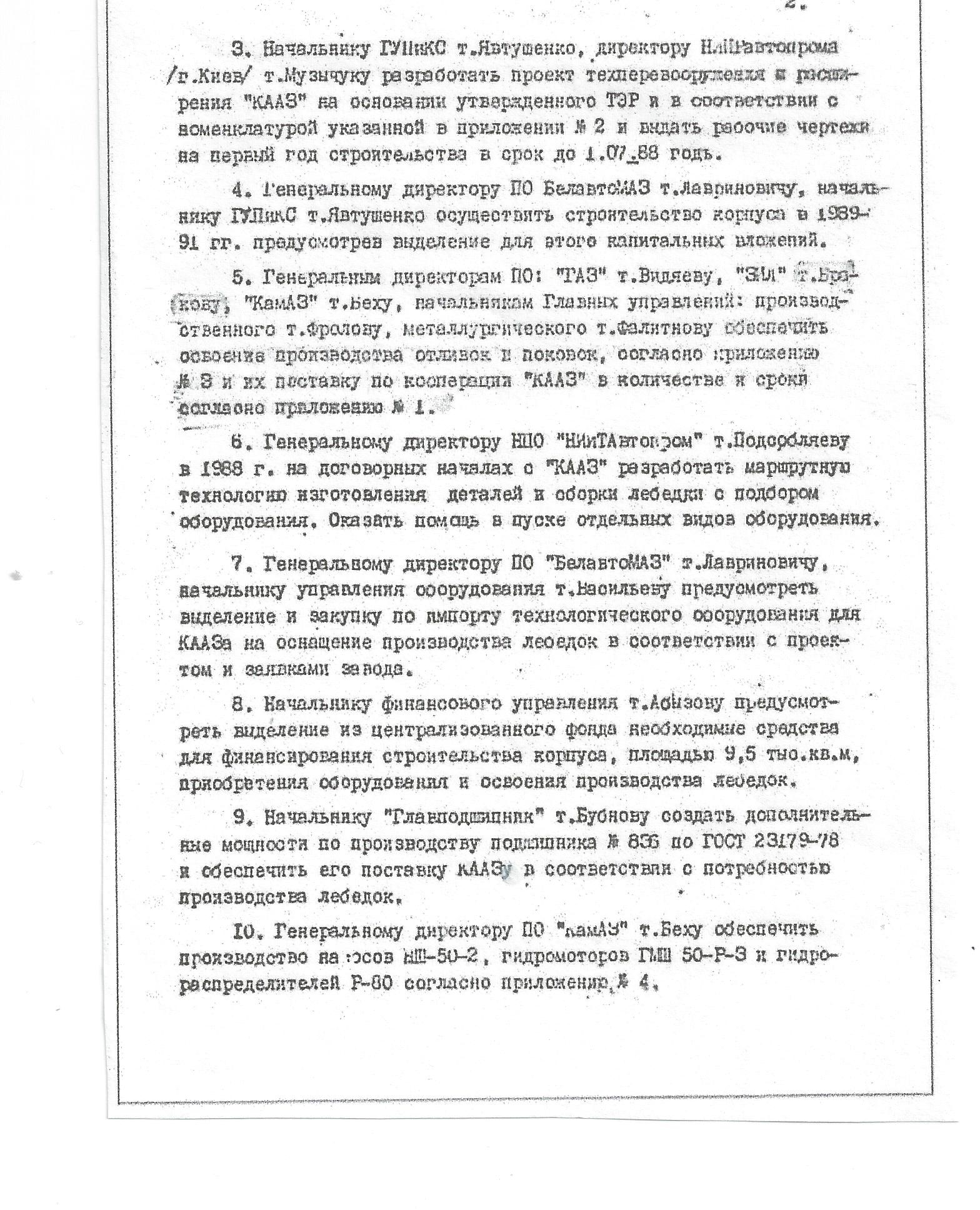
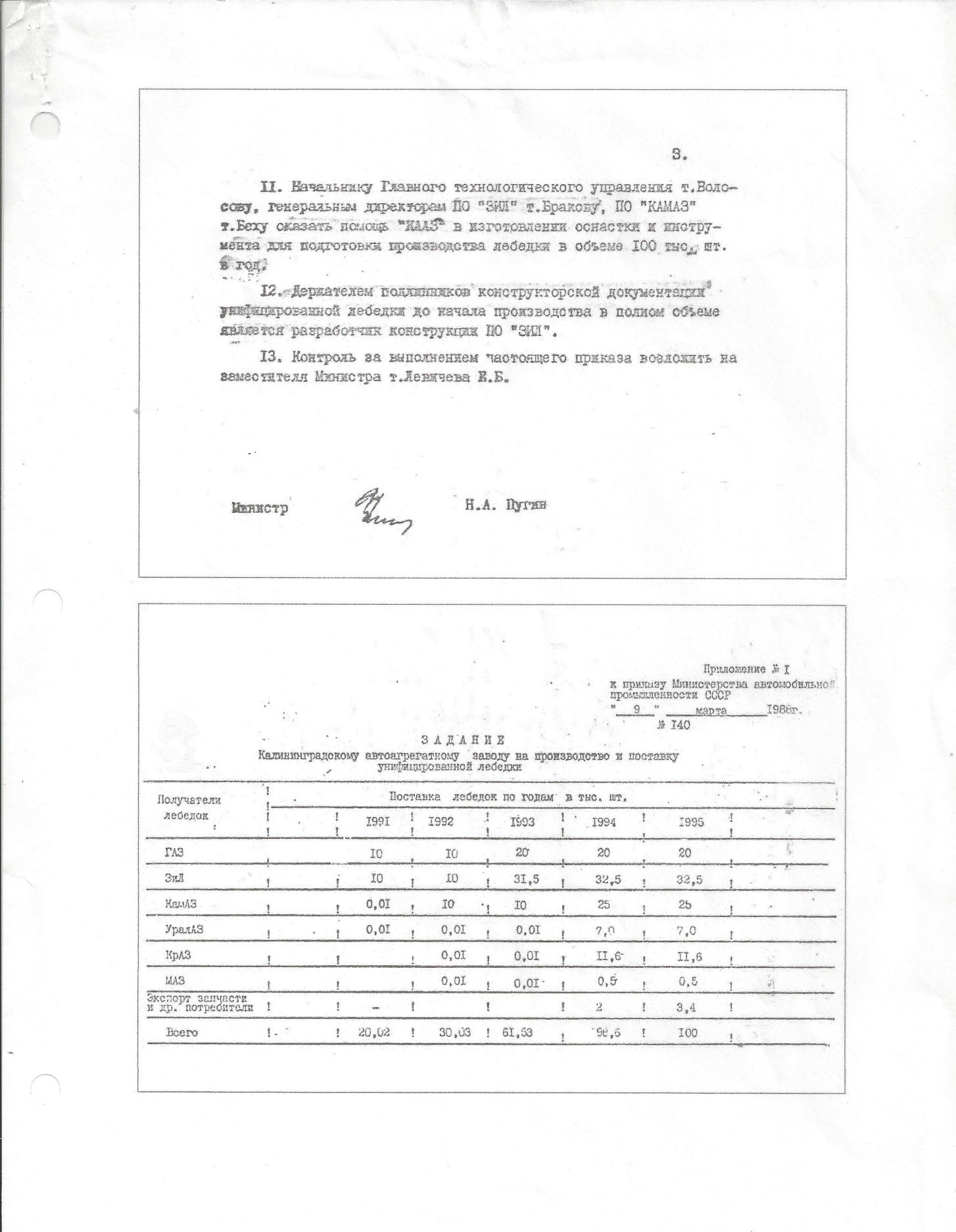
On May 9, 1988, the minister issued Order No. 140, “On Production of the Winch at the Kaliningrad Auto Assembly Plant” (Appendix No. 2). About a month later, the plant was separated from the KrAZ association and placed under the ministry’s direct authority.
At the request of KAAZ director Igor Igorevich Savchuk, Yu. A. Zosimov and I visited KAAZ twice, where we discussed with the plant’s chief engineer, Vasily Ivanovich Shoshenkov, how to organize the plant’s Chief Designer’s Office, Research Laboratory, and Quality Control Department (OTK).
In 1980, the harmonic gear mesh reducer was exhibited by ZIL in Moscow at the “Young Inventors” exhibition, in the “Exhibition of Achievements of the National Economy of the USSR” (VDNKh) pavilion. The listed authors were V. A. Zhizhenkov, A. I. Revin, and D. S. Kondratyev (I declined to be listed). They were awarded a silver medal and a cash prize.
Other Designs
With the aim of expanding the use of harmonic drives, in 1979 a design was developed for a jack with a harmonic gear reducer and electric motor, for the ZIL-4104 top-of-the-line passenger car (Fig. 10). (The electric motor was converted from a ZIL-130 starter motor.) The jack’s mass was 7.7 kg, compared with 8.3 kg for the production jack (item 111G-39133310). Lifting time was 13 seconds for the front wheel and 27 seconds for the rear; lowering time was 3–5 seconds less (Report No. 854-80). The jack was tested by raising one side of a ZIL-115 six times until the wheels lifted off the road; the vehicle’s full weight was 3,700 kg (Fig. 10). To reduce the lateral force generated while lifting the vehicle, the jack’s linkage mechanism included a device allowing the upper platform to follow the arc of that motion (Author’s Certificate). Battery discharge during a single-side lift, until one wheel left the ground, was less than 1% of a 120 Ah, 12-volt battery (as used on the ZIL-115 and ZIL-114). Current draw of the jack under maximum load was 50 A. The jack remained operable even with the supply voltage halved relative to nominal, in which case lifting time increased by a factor of 2 to 2.2. During bench testing of the jack, the maximum load applied was 5,000 kg, measured with a DOSM-3-5 No. 615 dynamometer.
In KEIR ZIL Report No. 237-83, the following conclusion was reached regarding the HGR jack: “The prototype jack, built according to the description in invention application No. 3375899/27-11, is operable, convenient to use, and recommended for adoption.”
I trust that a few lines about the social life typical of that era will not be considered excessive. At ZIL’s KEIR, which employed more than 2,300 people (1,090 of them workers, as of 1979), there was a chapter of the All-Union Society of Inventors and Rationalizers (VOIR). Its membership at various times ranged from 120 to 150 people, mostly highly skilled workers. The task of VOIR, together with the engineer responsible for inventive and rationalization work, was to help authors prepare applications for rationalization proposals and to assist in building various devices, arising from those proposals, that made work easier. Our design bureau often helped by doing the calculations and producing drawings for workers’ proposals. I was not a Party member, but for eleven years I was elected chairman of the KEIR VOIR council (unpaid, voluntary work). The VOIR council had five members, and re-election meetings were held every year; G. A. Materov was typically present at these meetings. Besides its main work, the VOIR council organized outings — for example, to the military aviation museum in Monino near Moscow, to the “Melodiya” recording studio housed in an Anglican church, and to sister enterprises. I found this work engaging.
In December 1991, the USSR collapsed. Perestroika began, and it affected ZIL profoundly — and not only ZIL, but most industrial enterprises across Moscow and the country as a whole. Although ZIL kept operating for a while, its decline was obvious. From time to time, wage payments were delayed by a week or more. Specialists began leaving the plant. Preparations for producing HGR winches at KAAZ in Kaliningrad came to a halt.
A New Job
In 1994, an international automotive equipment exhibition was held in Moscow. Among the exhibits, ZIL displayed two automotive winches with harmonic gear reducers and hydraulic drive, rated at 6 and 12 tons of pulling force. These winches drew particular interest from representatives of a major American automotive company. I was invited to the United States for a week-long interview. It went in a friendly atmosphere. There were some questions I could not answer, mostly having to do with computer technology — producing drawings on a computer. I did not try to bluff my way through; I simply said I didn’t know, but that I could learn. Our acquaintance took place not only formally, around a conference table, but in everyday settings as well. As a result of my interviews with the company’s management, as well as meetings with design engineers and process engineers, I was offered a contract to work as a project engineer (design), reporting directly to the chief engineer. They promised to set me up with a drafting board, and joked that they’d get a set of drafting instruments from an antique shop.
In 1995, my wife, our ten-year-old son, and I moved to the United States on a work visa. After three years on the job, a competitive selection process was announced for my position. (Under Department of Labor regulations, an American specialist takes precedence over a foreign one.) In the end, I was the one kept on as a result of that process. About six months before the selection process began, the company’s attorney had submitted my documents (my candidate-of-sciences diploma with abstract, a list of publications in scientific journals and collections covering the two main papers related to my candidate’s and doctoral dissertations, and my Author’s Certificates and patents). I was awarded a PhD in Mechanical Engineering. After ten years with the company, I retired at the age of 75.
I may write about my time working in America at some later point. In brief, life there was demanding, intense, and interesting — it felt almost like a return to my youth. The projects I worked on there were very different from what I had done at ZIL. The primary requirement was to create products competitive on the world market. At the company, each design engineer worked in a private office equipped with modern furniture and equipment; detailers and draftsmen worked in a shared, cubicle-partitioned space. Every office had a telephone and everything needed for work. Drawings were done exclusively on computer. I was given a drafting board and worked at it for the first two years, but even after that I was never fully able to make the transition to a “paperless” workflow, since I still made sketches of design variants by hand. During working hours there was no idle chat — no smoke breaks, no casual conversation even when passing in the hallway. Lunch was 30 minutes; there was a break room with coffee makers, microwaves, a refrigerator, and a vending machine selling ready-made lunches and juices. Occasionally engineers would go out to lunch at a small restaurant nearby. Annual vacation time was set as follows: one week after the first five years of employment, two weeks after ten years, and four weeks after twenty. Relations among coworkers and with management were friendly. Most people at the company worked there for many years, often right up until retirement.
After moving to the United States, I stayed in touch with friends and many colleagues in Moscow. We talk by phone and exchange holiday and birthday greetings, along with photographs, over the internet. For example, Edgar Borisovich Vulgakov sent me his monograph “Theory of Involute Gear Drives,” published in 1995, and, at his request, I received the memoir-novel about his life, “The Passage of Time,” published in 2007. In turn, I sent Edgar Borisovich chapters from the book I was working on at the time.
It is hard for me to turn the pages of my address book and see the names framed in black mourning borders: Igor Grigoryevich Sharov, Georgy Alekseyevich Materov, Vladimir Alexandrovich Zhizhenkov, Yuri Alexandrovich Zosimov, Iosif Vladimirovich Voloshinov, Edgar Borisovich Vulgakov, Igor Igorevich Savchuk.
S. I. Gorfinkel
- Biography, “On Solomon Izrailevich Gorfinkel” (presented here in abridged form), written by V. G. Mazepa, chief designer of ZIL. Published in the book “Reflections by the Closed Checkpoint” (edited by V. G. Mazepa and A. V. Kurkova, Moscow, Moscow Polytechnic University, 2018, 364 pp.).
- The article uses photographs of the author obtained from I. V. Voloshinov, as well as images from the ZIL archives, which are credited accordingly.
- The report numbers cited are official documents confirming the results and dates of the tests referenced.
Reviews of the article: pp. 47–49. Ye. A. Bashindzhagyan’s review of the HGR is taken from a letter to the author of the article.
Published in the book “Reflections by the Closed Checkpoint” (ZIL 100th Anniversary), 2018.
Appendix 1
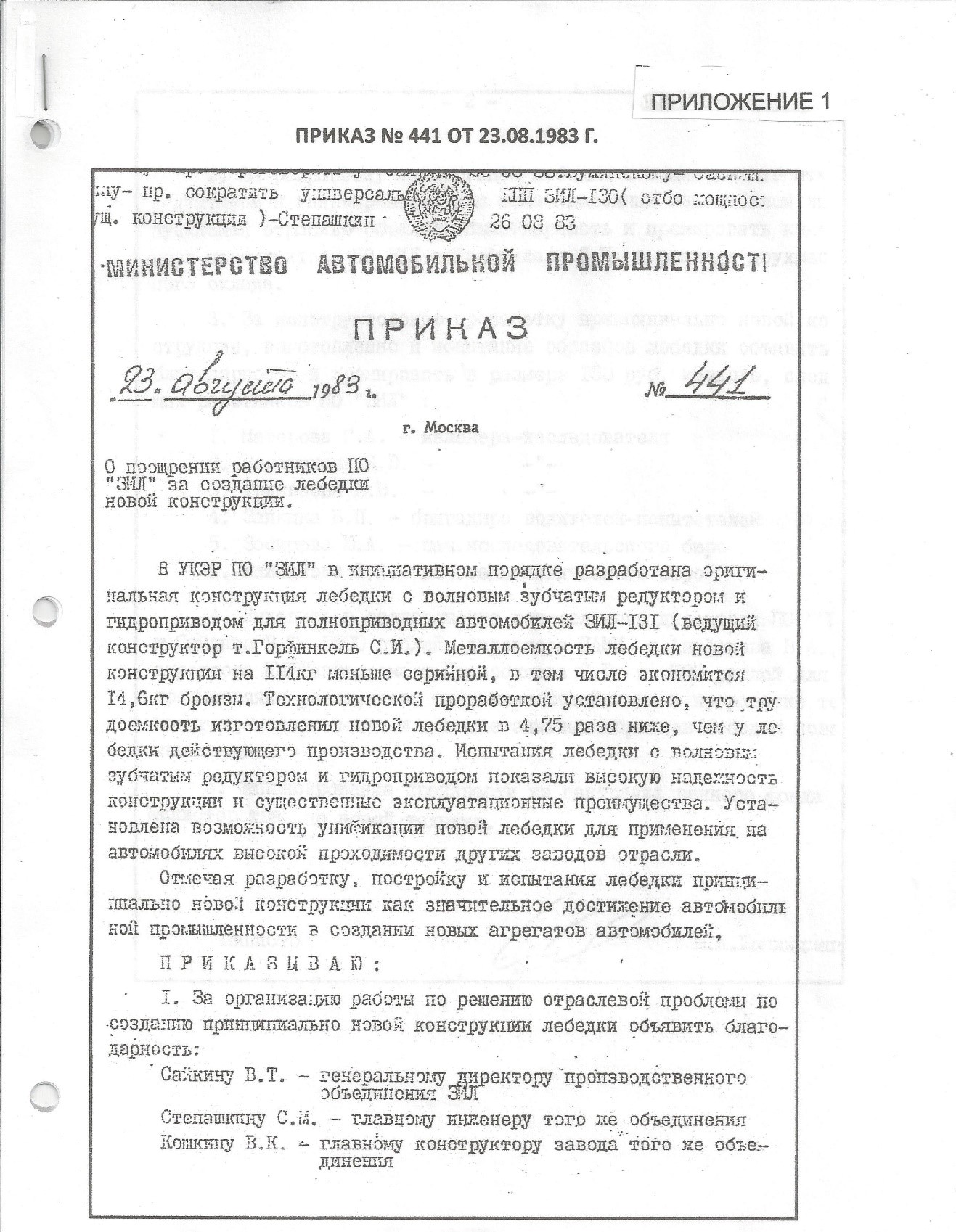
Ministerial Order No. 441 of August 29, 1983 (pp. 24–25).
Appendix 2
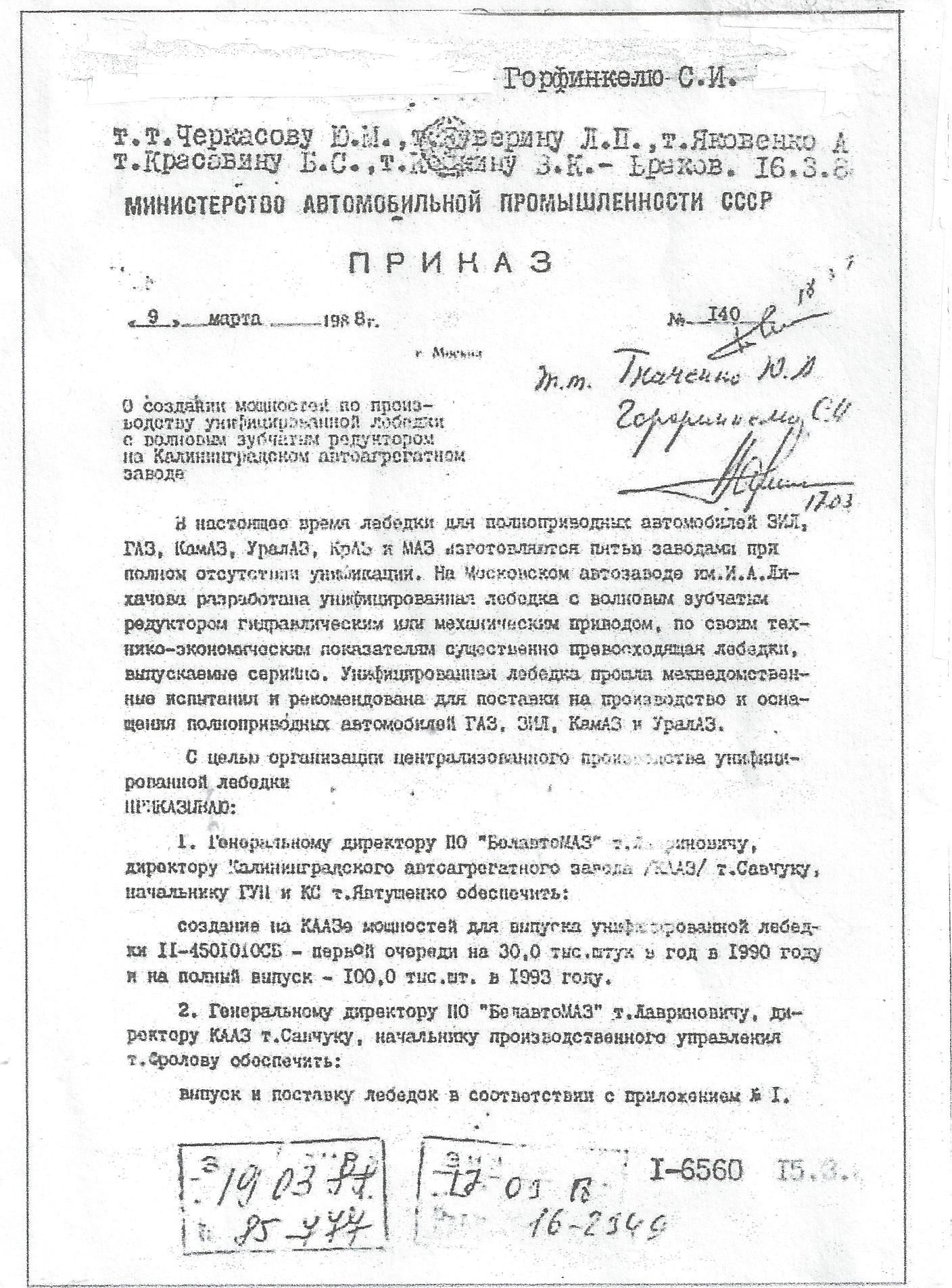
Ministerial Order No. 140 of March 9, 1988, “On Establishing Production Capacity for a Unified Winch with Harmonic Gear Reducer at the Kaliningrad Auto Assembly Plant” (pp. 26–28).
Designs
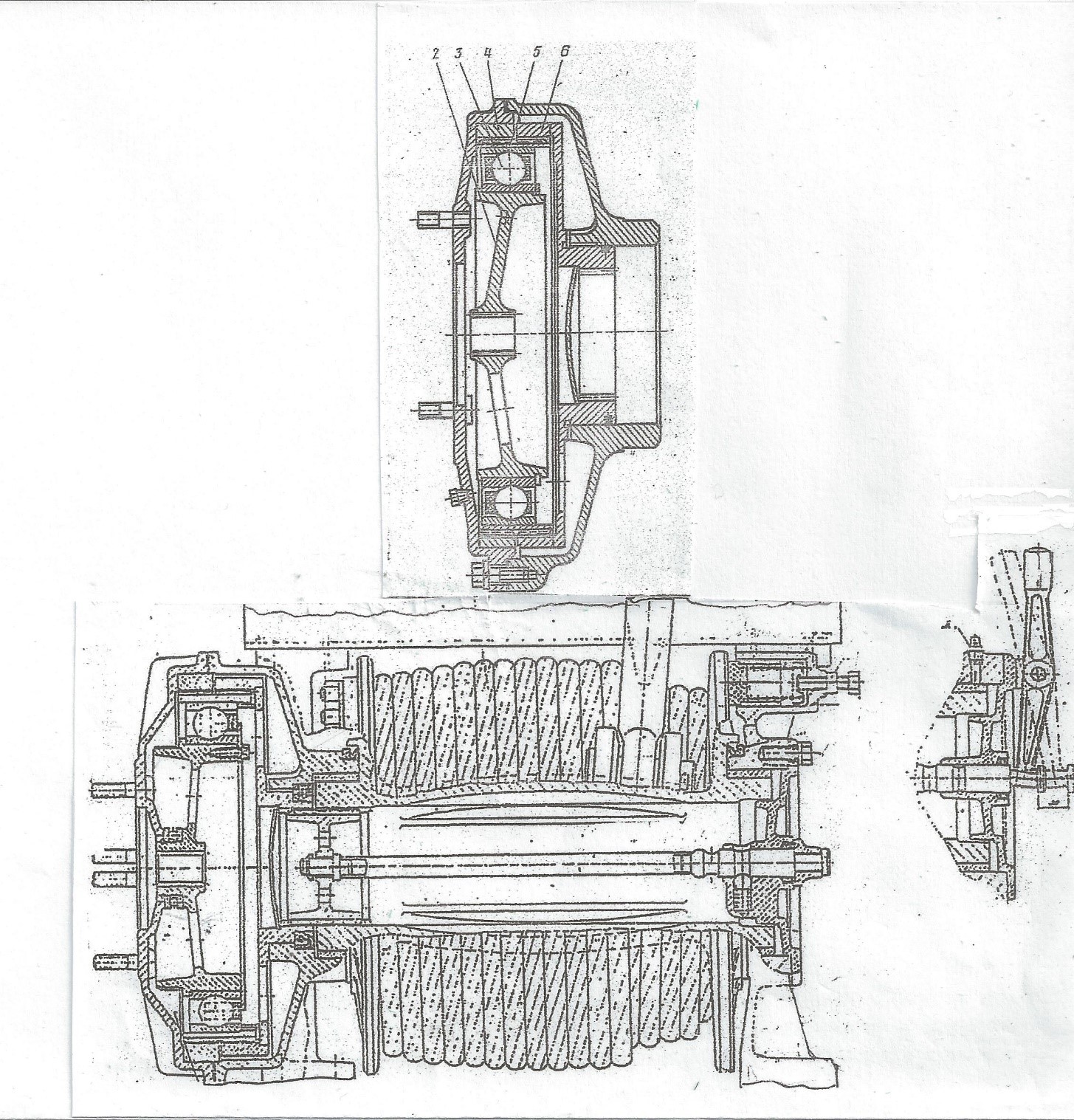
Fig. 1. Top: drawing of the harmonic gear reducer. In the drawing: 2 — cam; 3 — flexible bearing; 4 — rigid gear wheel; 5 — flexible gear wheel; 6 — coupling. Reducer gear ratio: 122.
Bottom: drawing of the winch with harmonic gear reducer for the ZIL-131 (pp. 29–30).
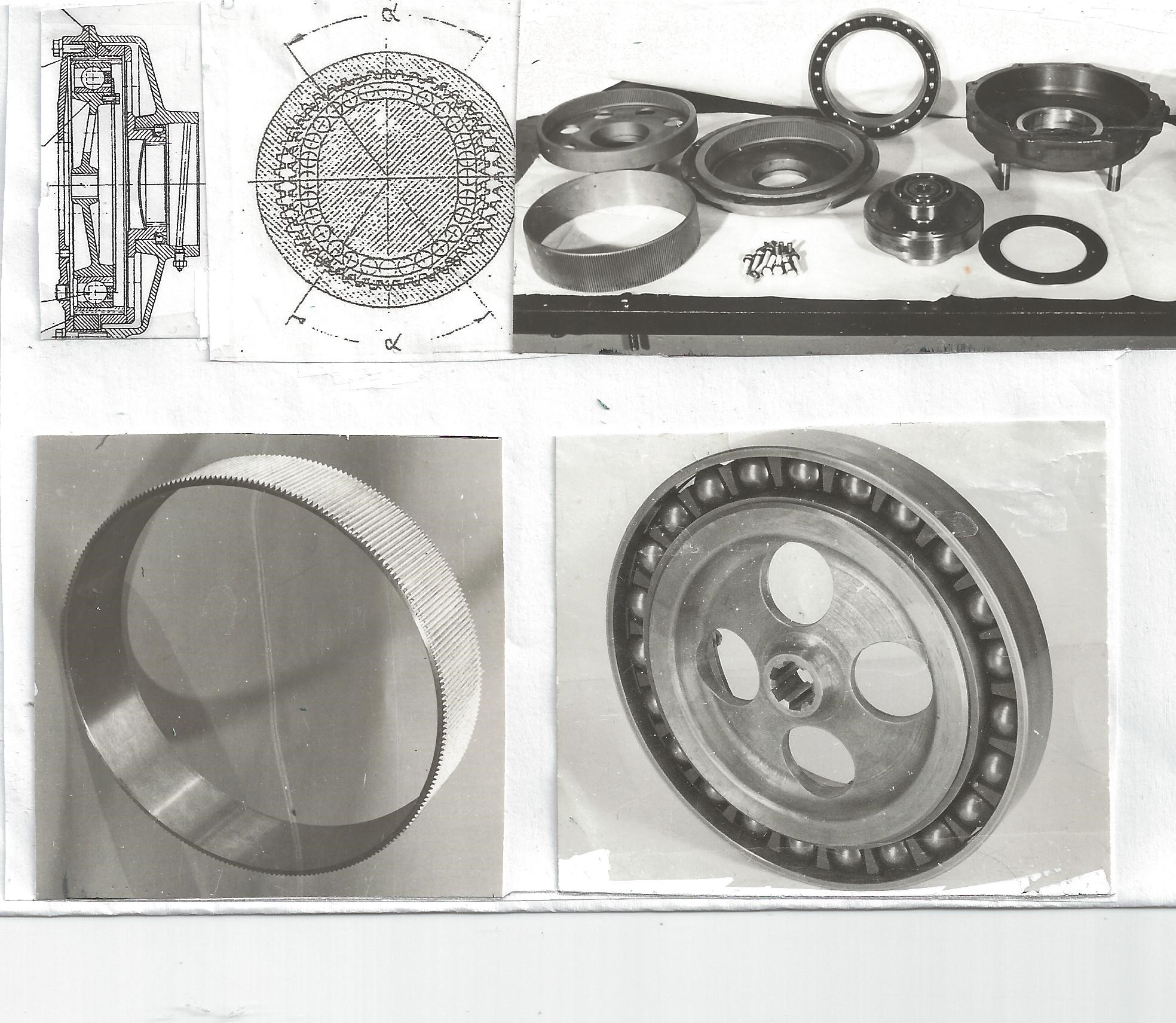
Top: left — drawing of the reducer and diagram of the harmonic gear mesh, where a is the contact angle of the meshing gear teeth. Right: reducer components.
Bottom: photo of the flexible wheel and cam, assembled with the flexible bearing.
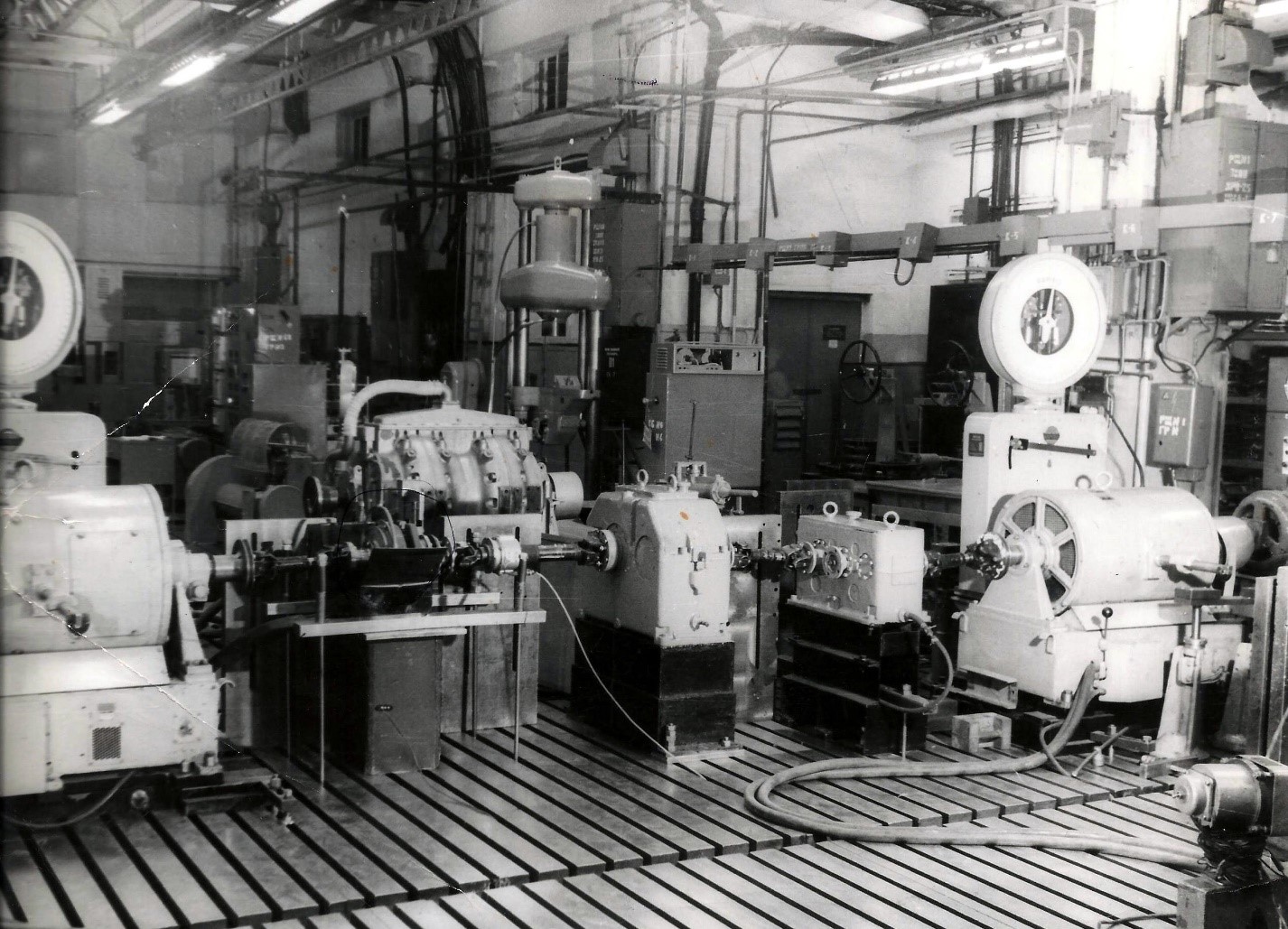
Fig. 2. Bench testing of the harmonic gear reducer at ZIL’s KEIR.
(From the ZIL archive)
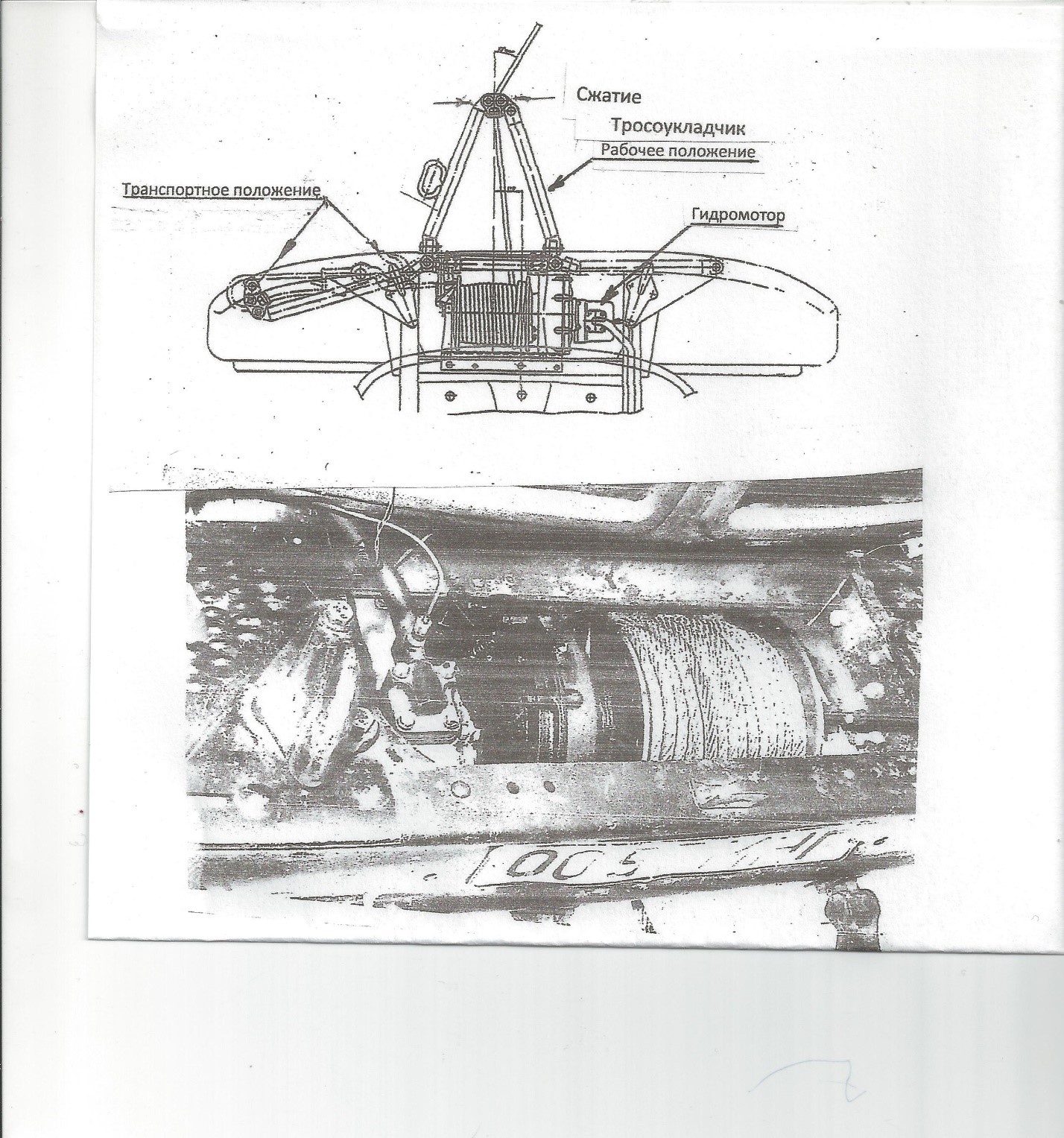
Fig. 3. Top: drawing of the winch, assembled with HGR, hydraulic motor, and cable-laying guide, installed on the ZIL-131. The cable-laying guide compresses the cable only while it is being spooled onto the drum.
Bottom: photograph of the winch installed on the ZIL-131.
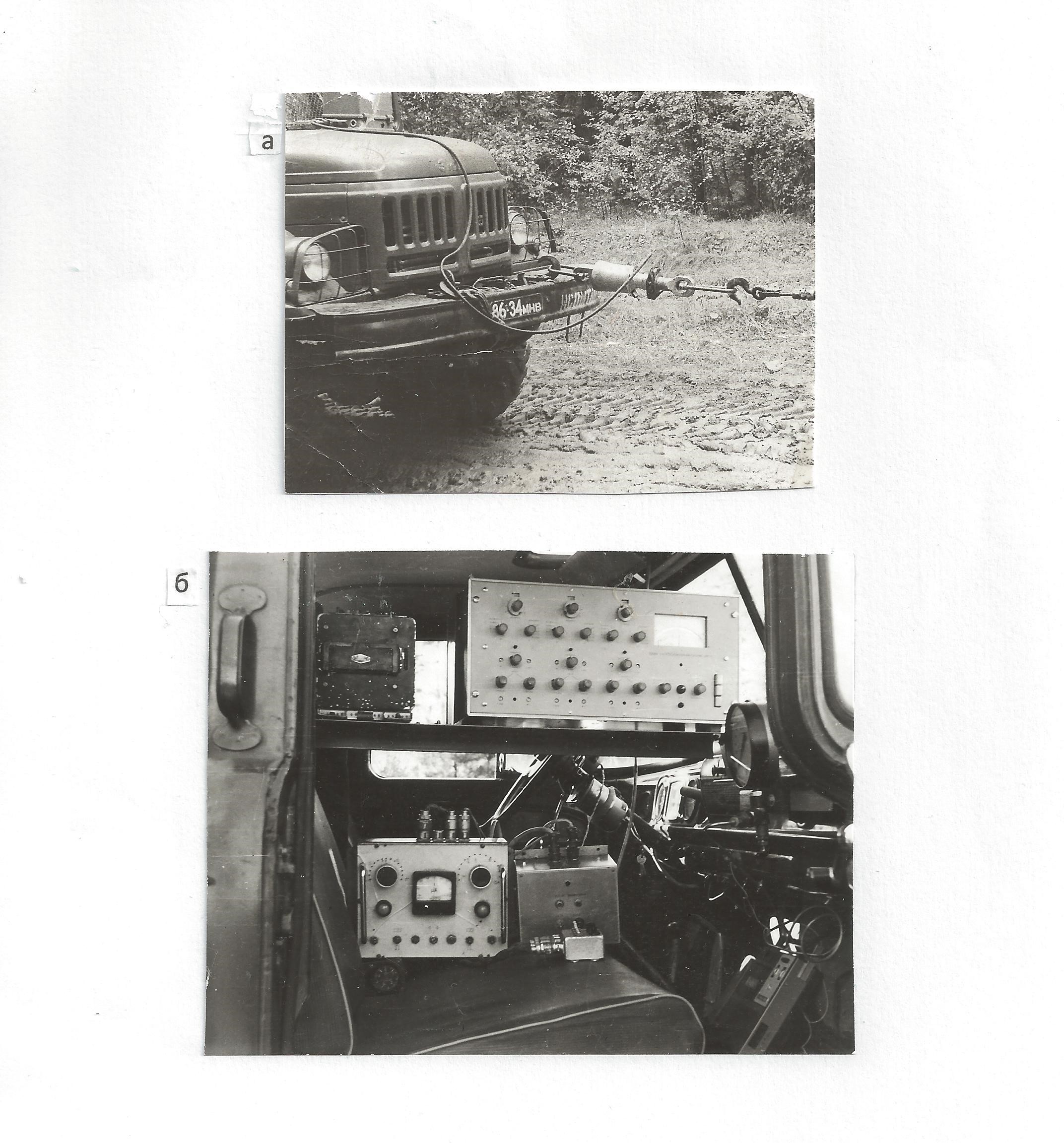
Fig. 4. Testing the winch with the harmonic gear reducer.
Top: a. Load sensor.
Bottom: b. Instruments in the ZIL-131 cab.
(Photos from the ZIL archive)
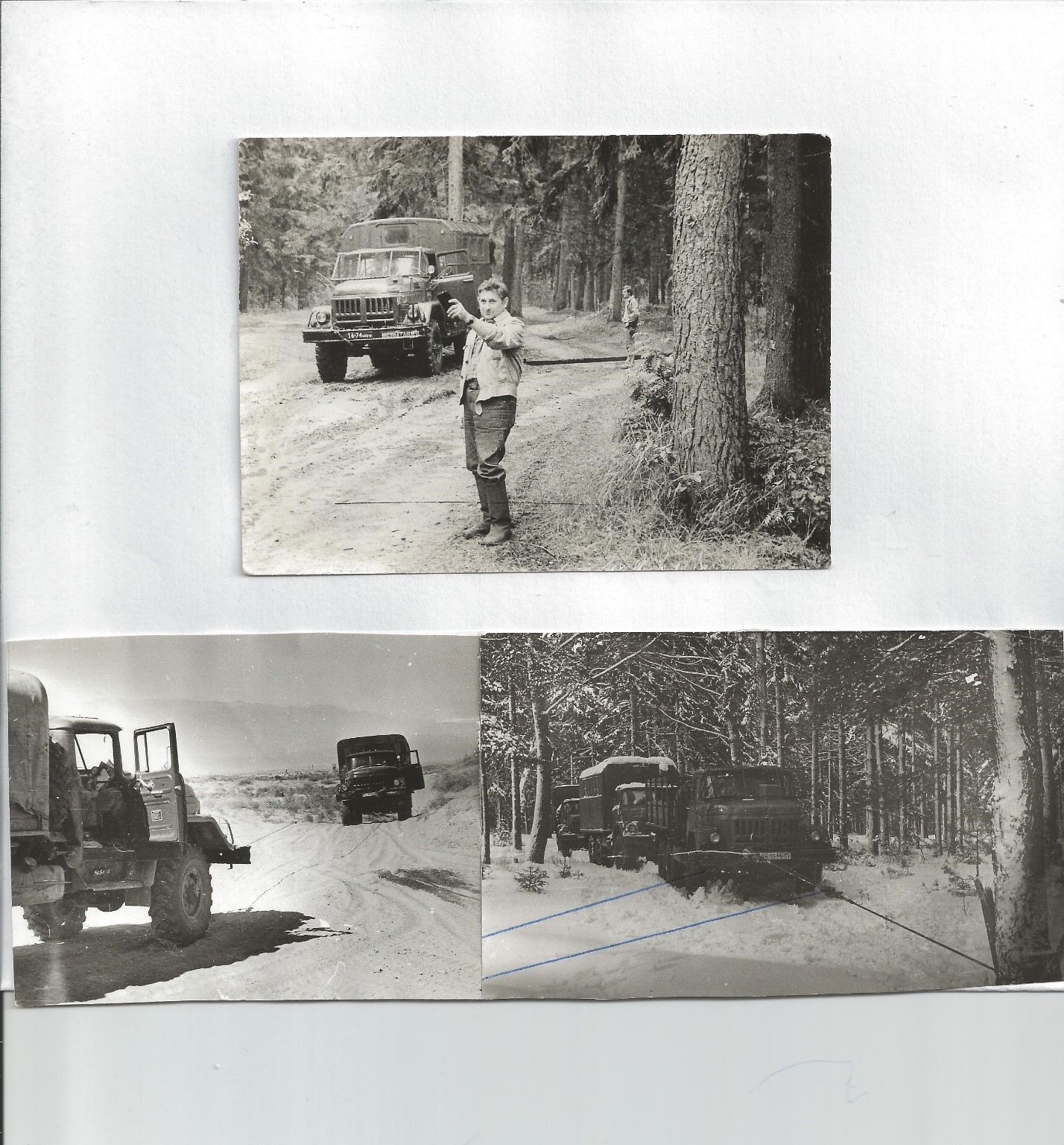
Fig. 5. Top: a moment from testing at the Konakovo proving ground, near Moscow, 1981 (S. I. Gorfinkel is in the foreground).
Bottom: left — testing in hot desert terrain; right — testing in the north (Ukhta). (Photos from the ZIL archive.)
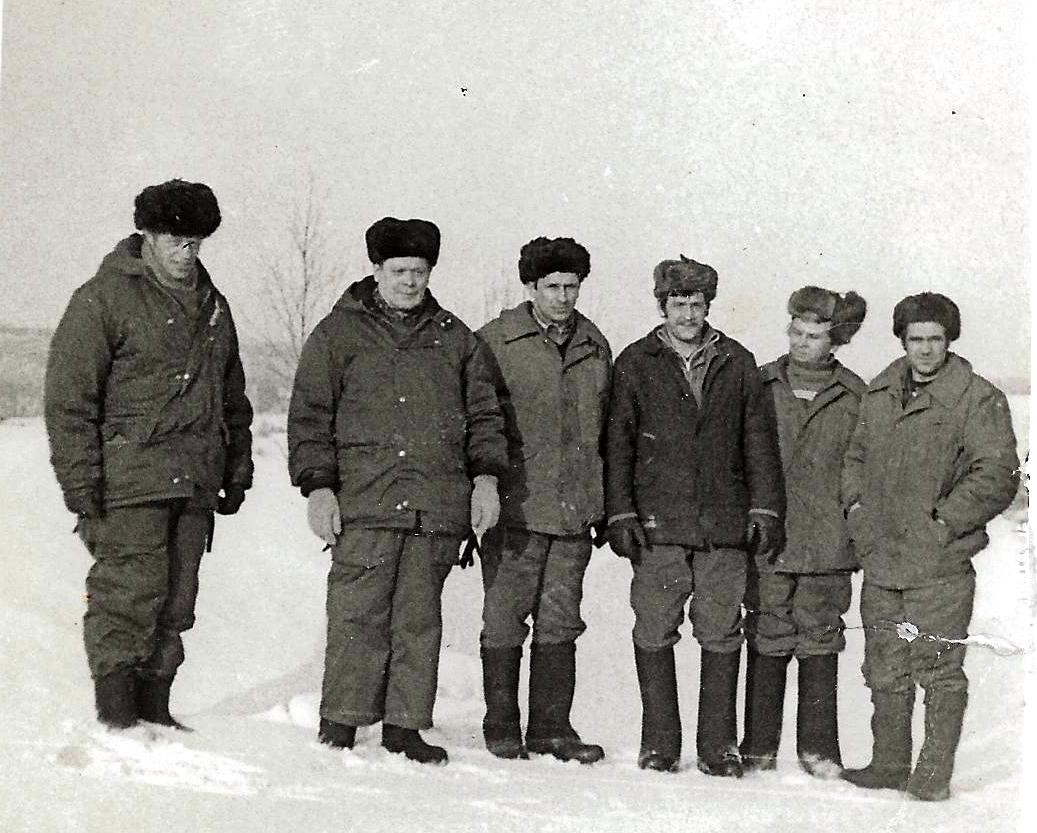
Fig. 6. Test drivers.
Far left: Iosif Vladimirovich Voloshinov, research engineer. Far right: Boris Petrovich Zaikin, foreman of the test drivers. (Unfortunately, I do not clearly recall the names of the other test drivers.) Ukhta (Komi), 1982.
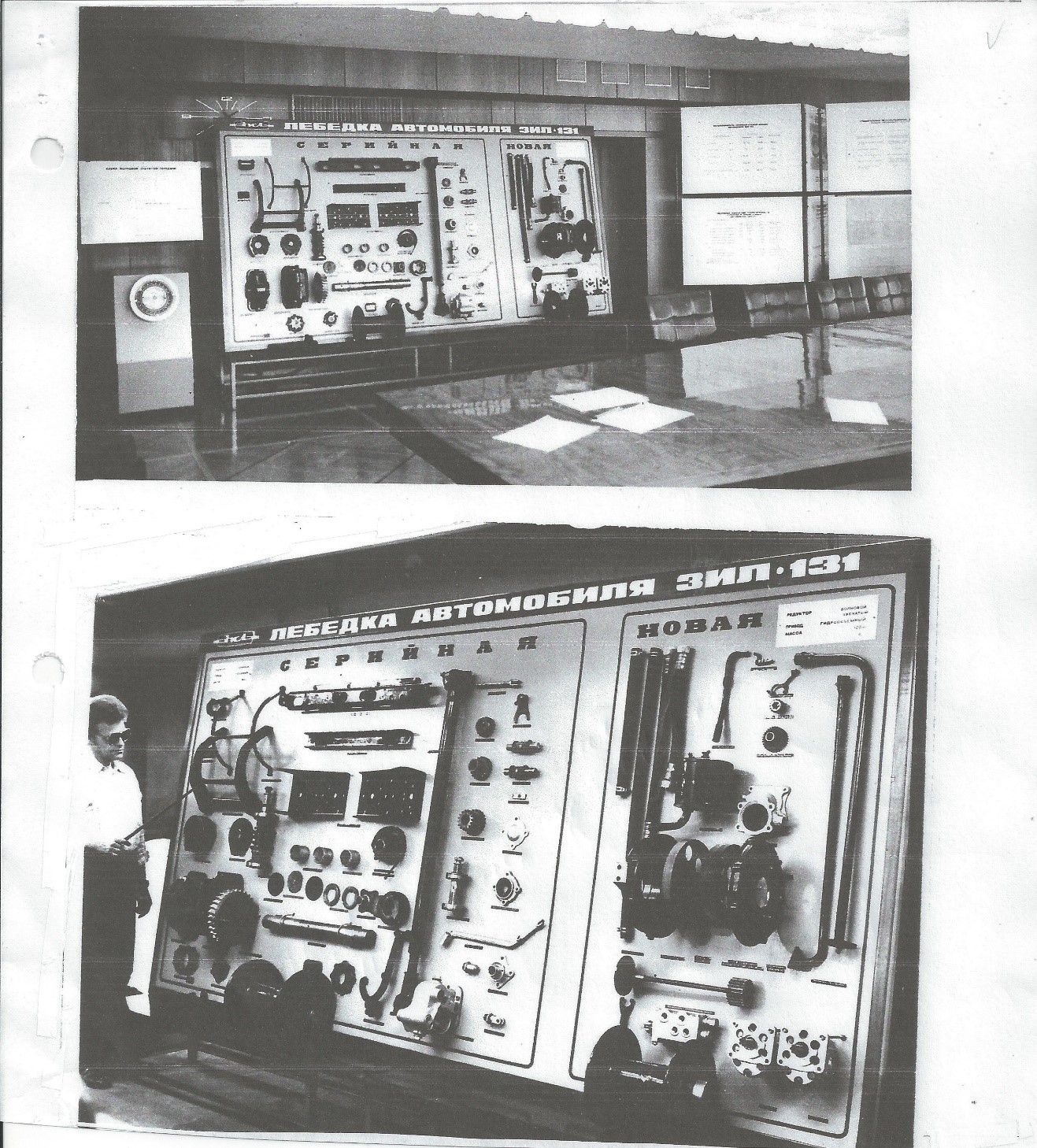
Fig. 7. Top: informational materials in the office of the ZIL Production Association’s general director. Bottom: I. V. Voloshinov at the information stand (pp. 36–37).
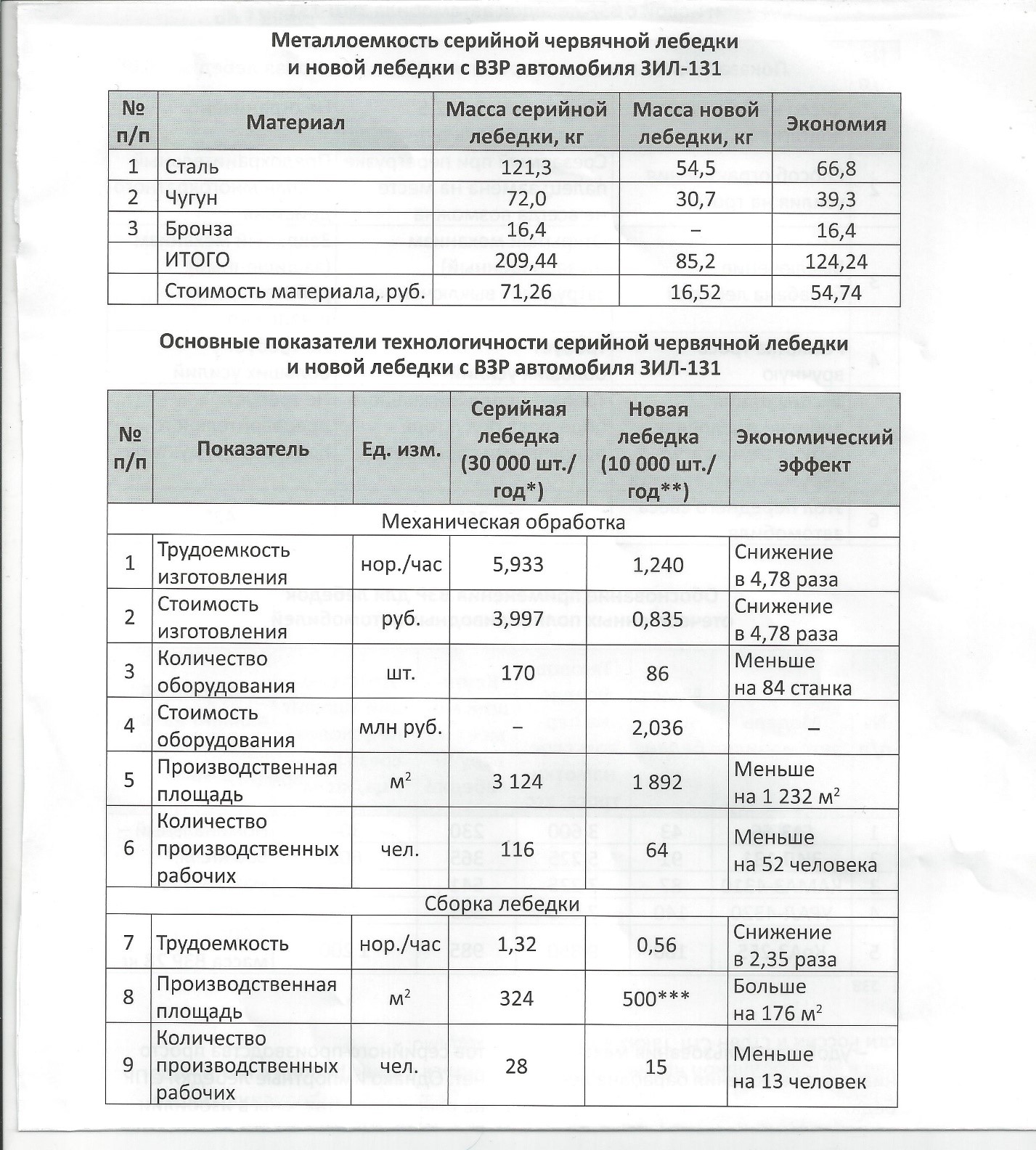
Poster with technical and economic figures, based on data from ZIL, BAZ, and NIITavtoprom.
* BAZ data. ** Calculated data from NIITavtoprom.
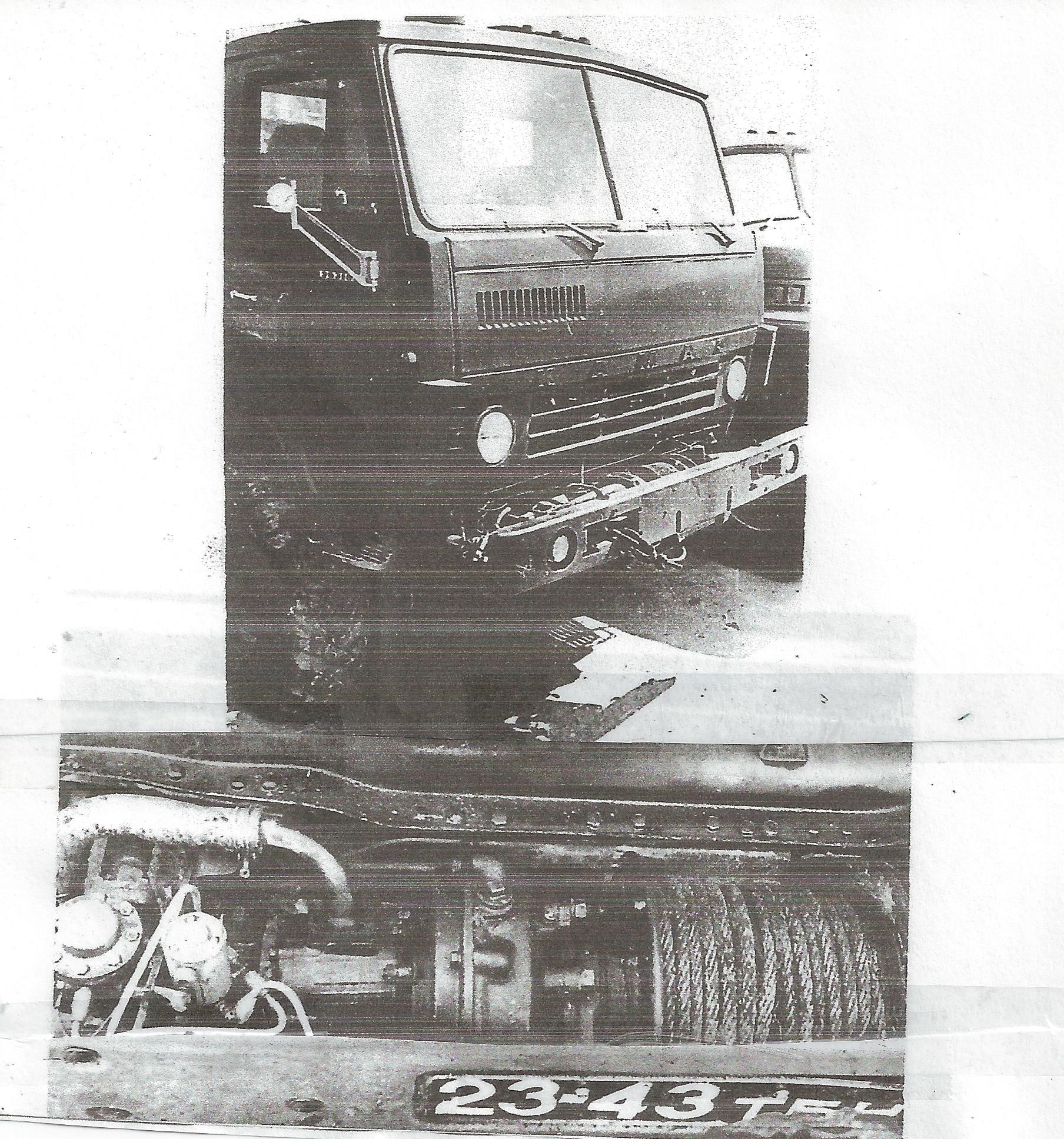
Fig. 8. Installation of the harmonic-gear-reducer winch with hydraulic motor at the front of the frame on the KamAZ-4310.
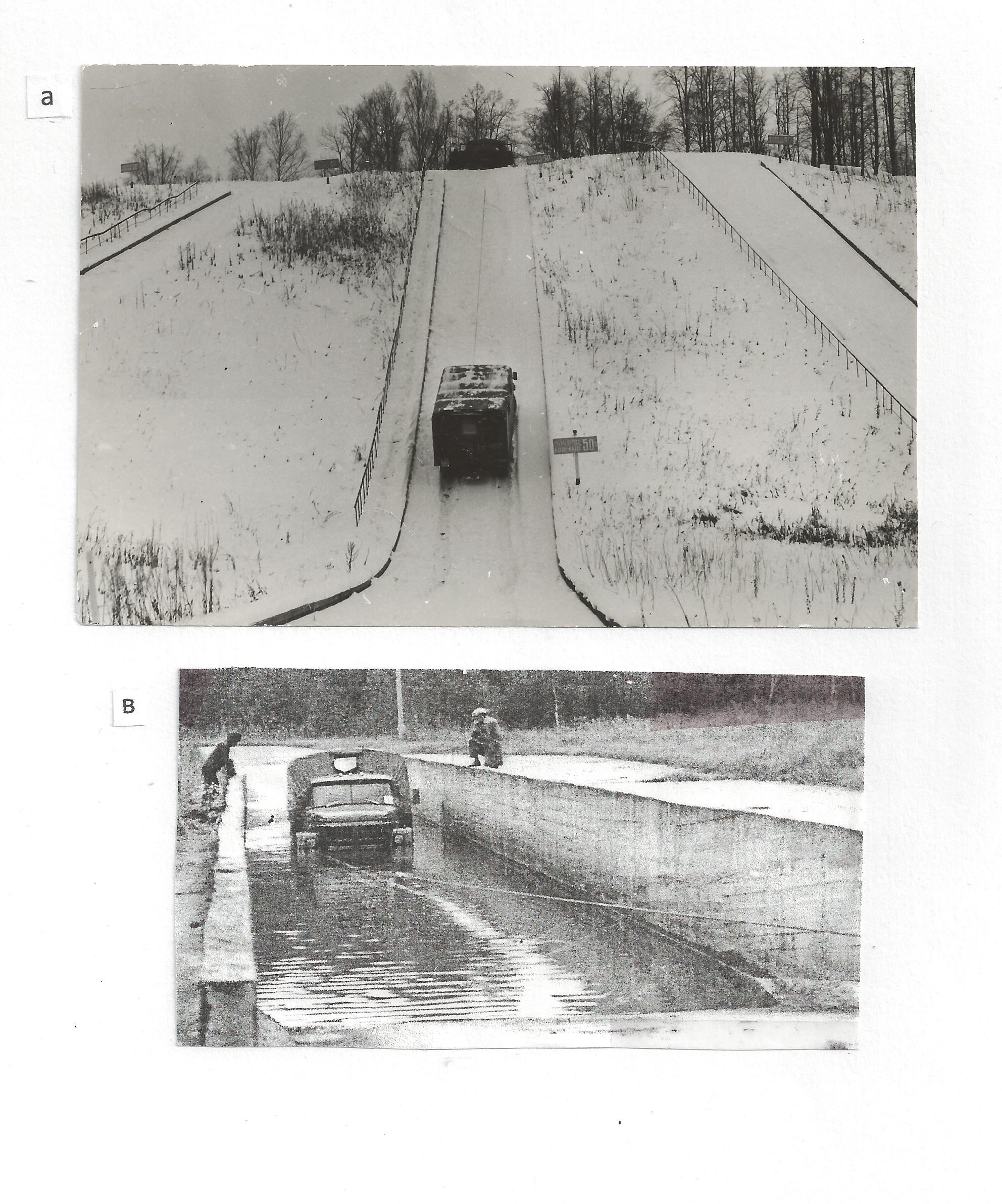
Fig. 9. Testing of the harmonic-gear-reducer winch on the ZIL-131. Top: climbing a slope. Bottom: submerged in water (from the ZIL archive).
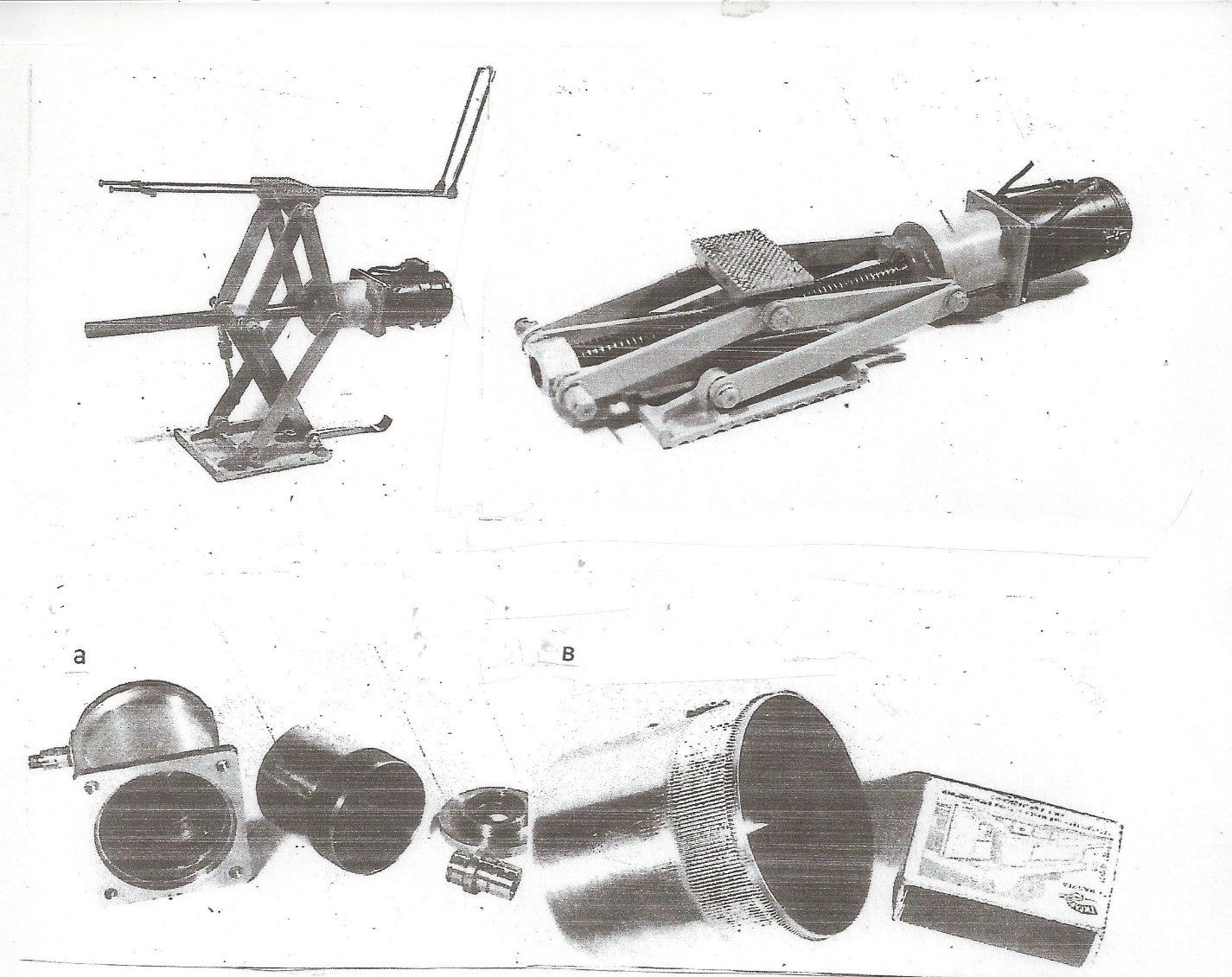
Fig. 10. Jack with harmonic gear reducer and electric drive. (pp. 40–41).
Top: photo of the jack in its two extreme positions. Bottom: a. Components of the harmonic gear reducer; b. Flexible gear wheel.
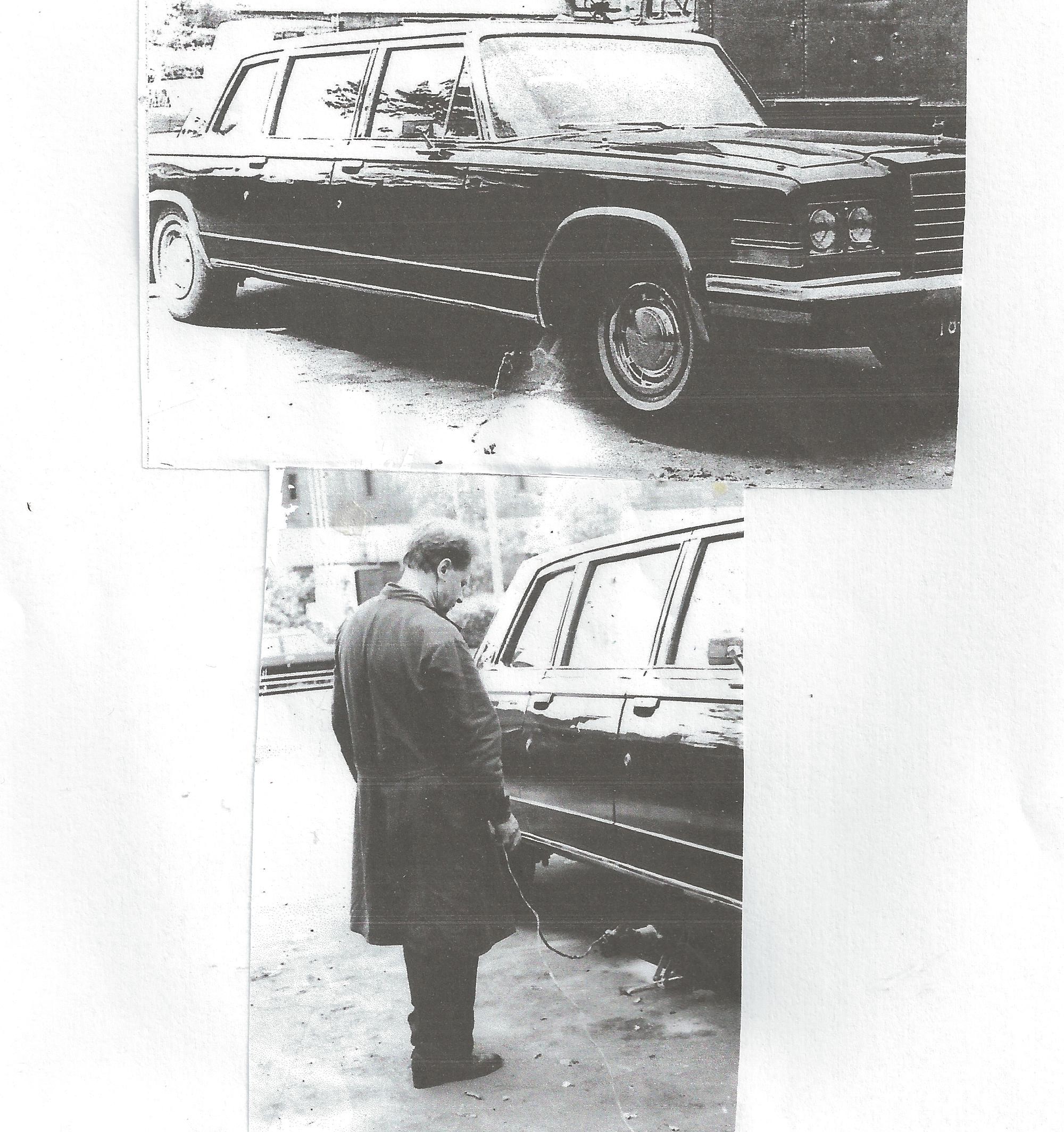
Moments from testing of the jack with HGR and electric drive. Top: raising the front wheel of a ZIL-4104. Bottom: testing the jack by lifting the vehicle until both wheels on one side left the ground (vehicle weight: 3,400 kg). Pictured: Alexander Dmitrievich Shavrin, specialist at the KEIR ZIL instrumentation laboratory.
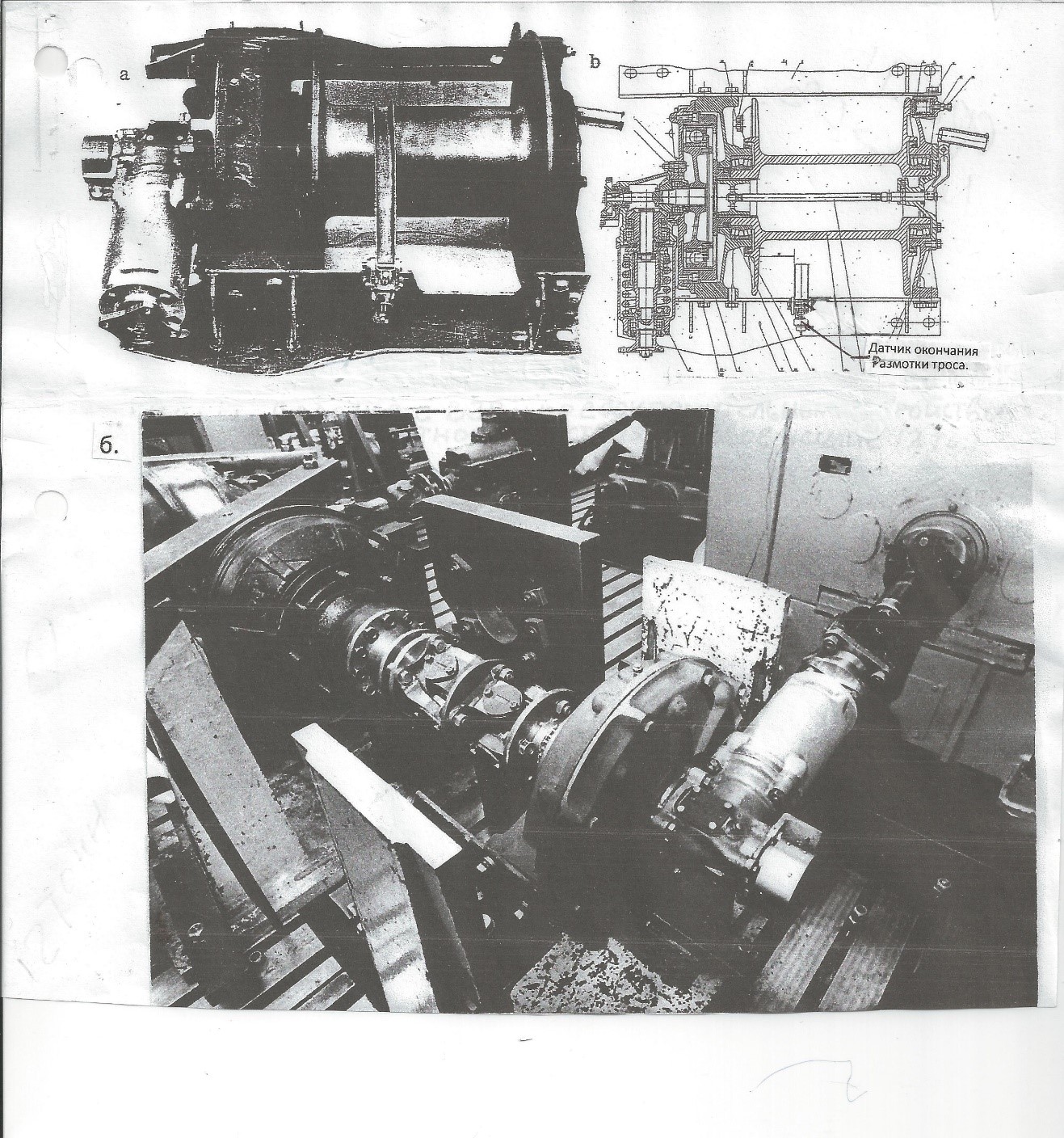
Fig. 11. Top: a. Photo of the HGR winch for the KrAZ-255; b. Drawing of the winch. Bottom: testing of the harmonic gear reducer and overload protection device for the KrAZ-255, on the test bench at KEIR-ZIL.
(From the ZIL archive)
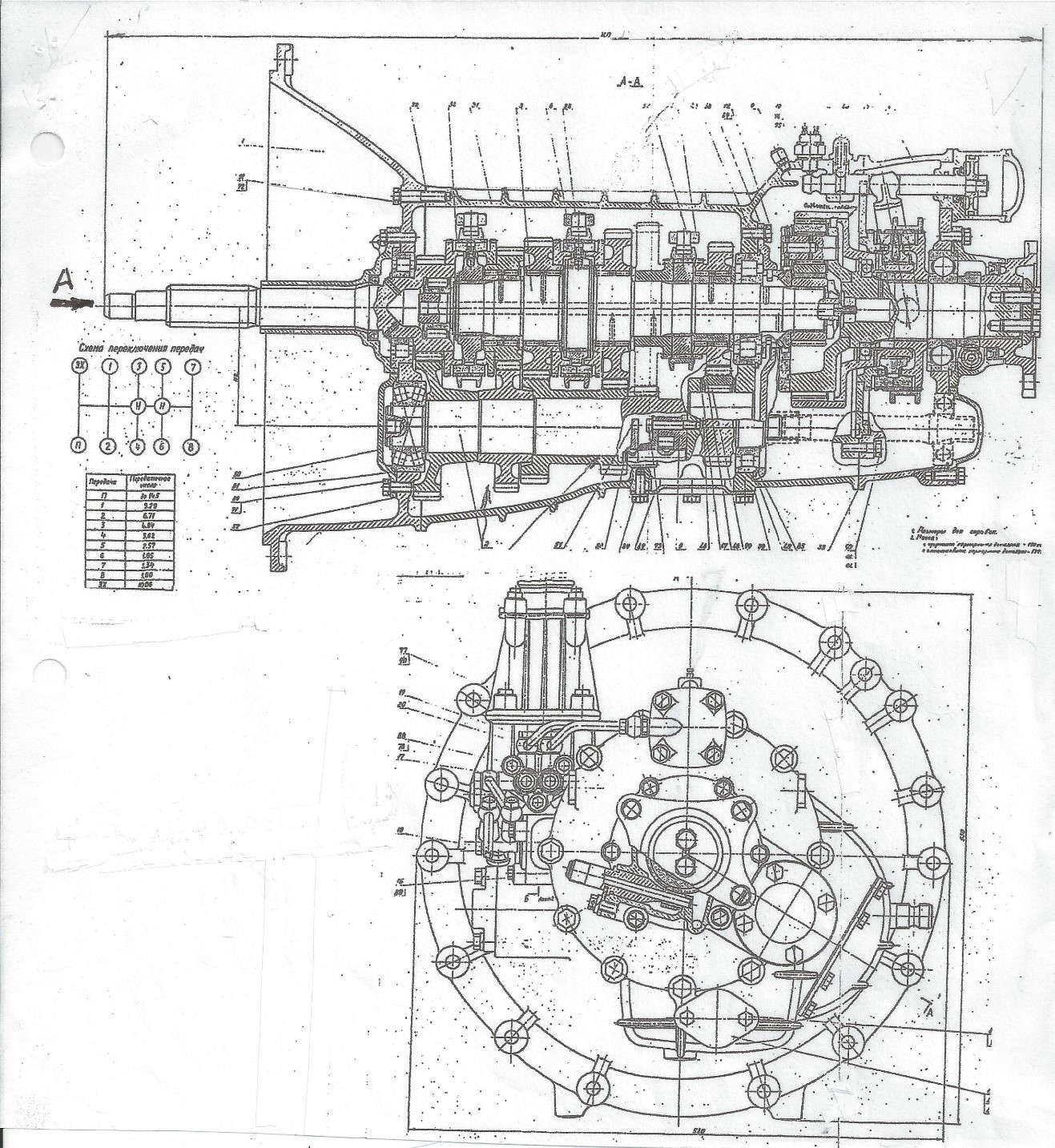
Fig. 12. Drawing of the gearbox with planetary underdrive unit for ZIL vehicles. (Dashed line shows the shaft connecting to the HGR winch pump drive.)
Below: view along arrow A.
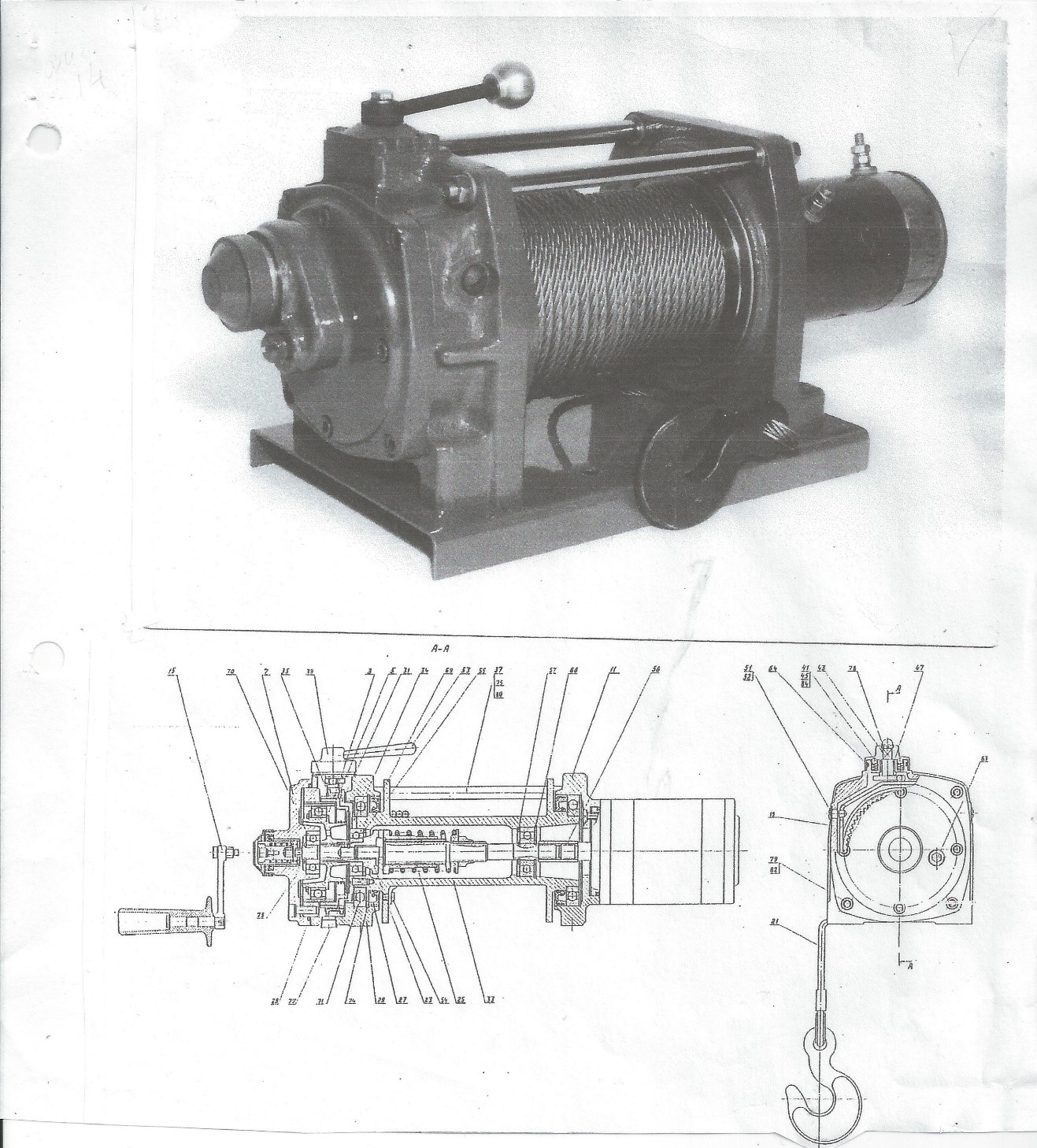
Fig. 13. Top: winch with harmonic gear reducer and electric motor, 2.2-ton pulling force. Bottom: drawing of the 1-ton-pulling-force winch.
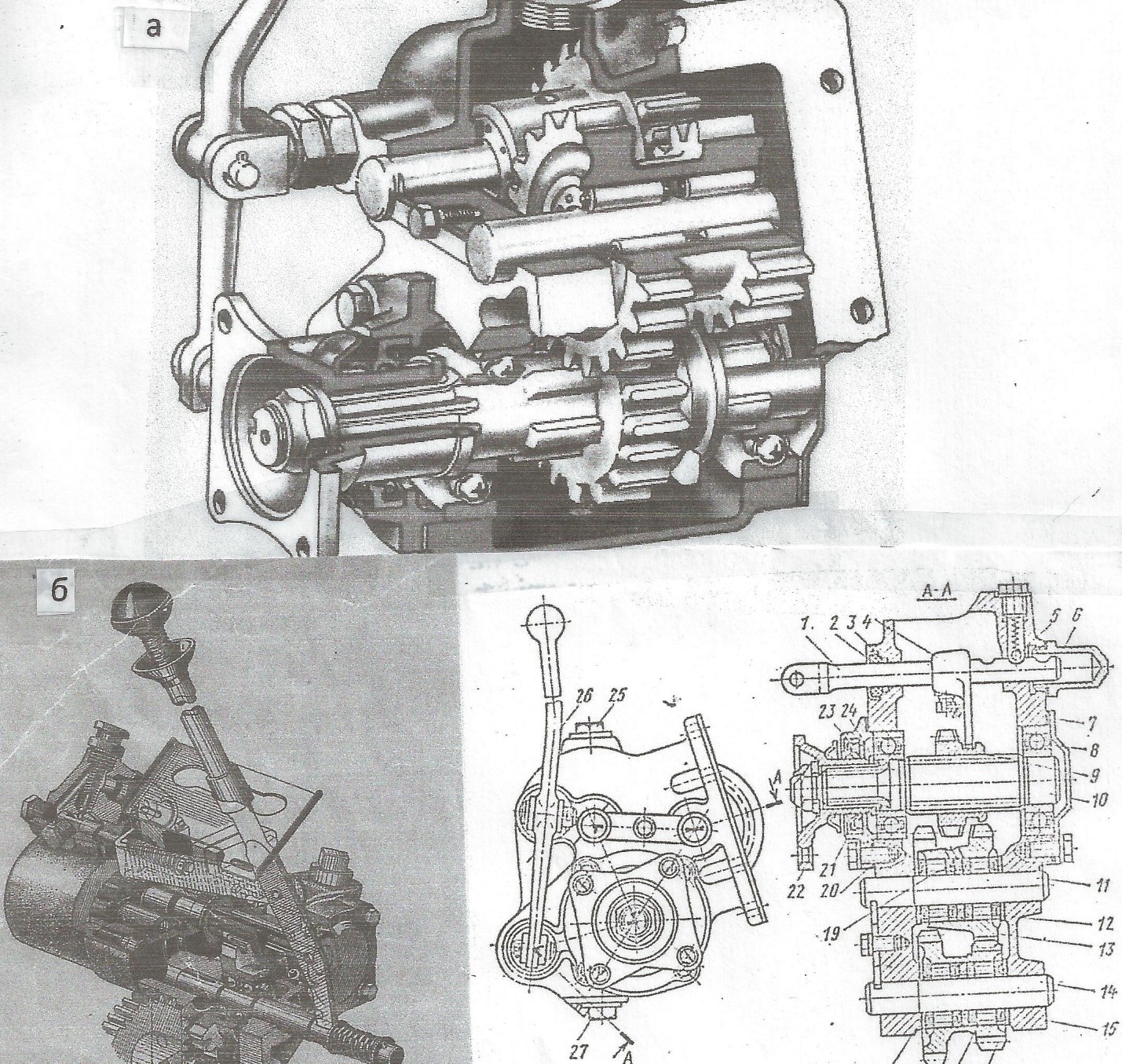
Fig. 14. Power take-off units (PTOs) on ZIL vehicles. a. PTO for the cardan-shaft drive of the winch on the ZIL-131. b. PTO for the hydraulic pump drive, with its drawing, on the ZIL-MMZ-555 dump truck.
(From the ZIL archive)
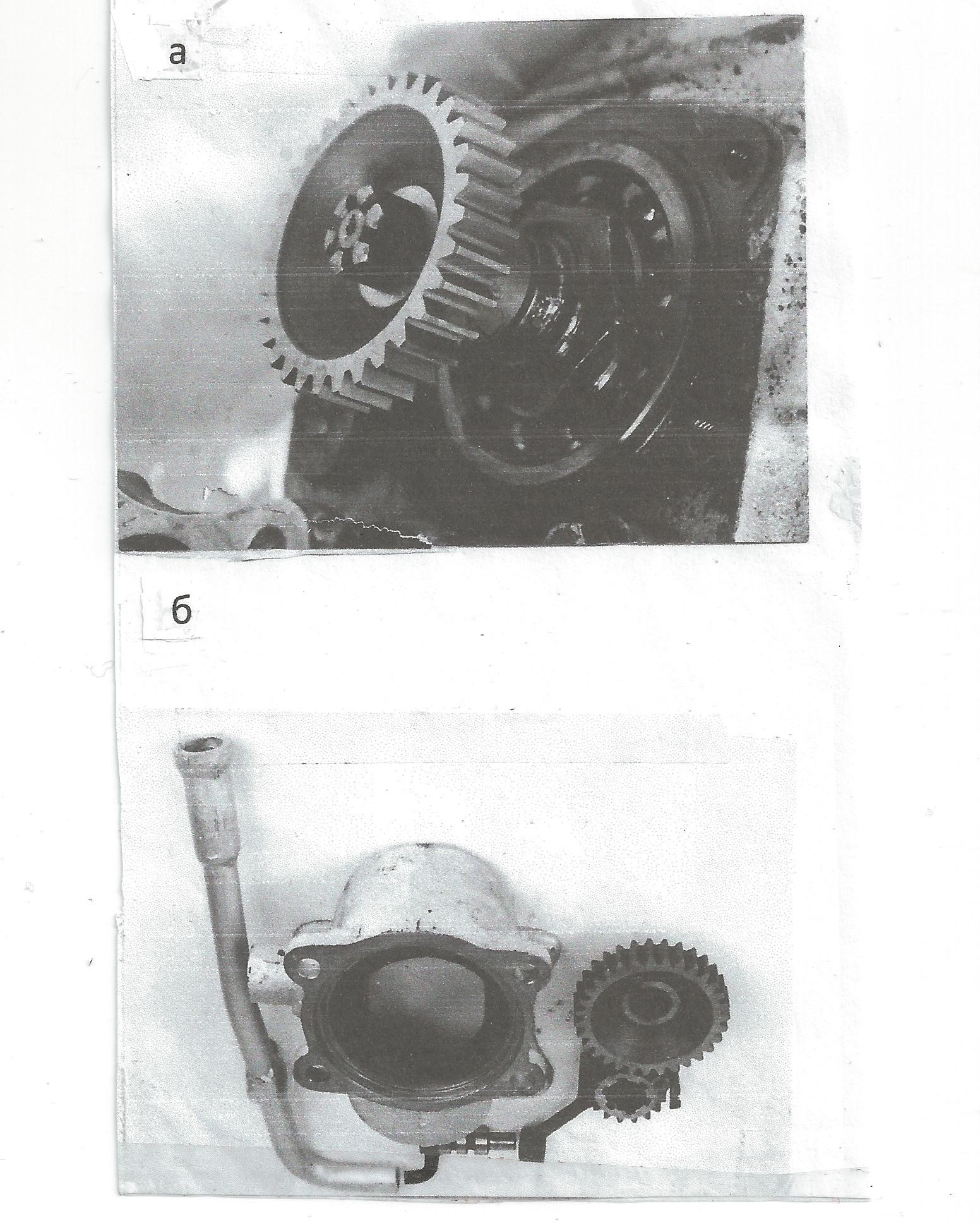
Fig. 15. Photo of components of the new (prototype) power take-off unit for the pump drive of the harmonic-gear-reducer winch, which passed testing on the ZIL-131 (Reports No. 4141-83 and No. 4142-83).
a. Installing the gear on the ZIL-131 gearbox shaft.
b. Power take-off unit components: housing, two gears, and the lever for engaging the gears that activate the pump. The gear shown in the lower photo is mounted on the pump shaft.
Reviews of the Article
Vladimir Grigoryevich Mazepa
Chief designer, ZIL Production Association; member of the Union of Writers of Russia
I read your account of the colleagues with whom you created, researched, refined, and repeatedly tested the HGR winch on our industry’s vehicles with great impatience and pleasure. What emerged are warm, humane recollections about people. Through these people, one sees the intricate web of obstacles surrounding a new, groundbreaking assembly on its difficult path to recognition. Thank you. Good luck.
Igor Sergeyevich Stepanov
Candidate of Engineering Sciences; chief designer at the ZIL Production Association for top-of-the-line passenger cars and buses; professor at the Moscow Polytechnic University (MAMI)
I read the article with tremendous pleasure, and it left me a little wistful — so many memories! I remembered all the fellows Solomon writes about, and the bosses too. My overall impression is that a tremendous amount of work went into this. It’s good that this work happened at all. That’s happiness!!!
- The spelling quirks are trivial — one just has to read carefully and not be too lazy to hit the space bar.
- On the whole, it’s very well written, in good language, and thoughtfully composed.
- It would help to picture who the readers will be. The details about specific people are interesting to me, and probably to other people who aren’t so young and might have known them. The same goes for the design details and drawings. And speaking of the designs — they’re magnificent! I say that because I understand them… but what about other potential readers?
Overall verdict: WELL DONE!!! And what a memory!!!
In short — I got a little wistful, but it’s a bright kind of wistfulness… It’s good that all this happened.
Mark Adolfovich Yutkevich
Candidate of Engineering Sciences; head of the department for research and development of ZIL’s top-of-the-line passenger cars
I read your wonderful article again with enormous pleasure. What I enjoyed most wasn’t even the technical details — interesting as they genuinely are for engineers — showing the path from an idea to a large-scale, industry-wide, revolutionary overhaul of the traditional approach to familiar solutions. It’s your respectful and well-earned attention to the people involved in this tremendous effort that is truly beyond praise, fair, and deserved — I knew all of them, and I fully agree with your assessment of each. It would be very interesting if you could also describe your “American life” in all its aspects, since so much of what we imagine here is idealized and far from reality. Thank you again for this immersion in a very good shared past of ours. With respect, Mark.
Valentin Mikhailovich Polonsky
Doctor of Pedagogical Sciences, professor, corresponding member of the Russian Academy of Education
I am not a specialist in engineering, but I read S. I. Gorfinkel’s article, “The Difficult Path of the Harmonic Gear Drive,” and the biography “On Solomon Izrailevich Gorfinkel,” written by ZIL’s chief designer, with interest and close attention.
The author tells the story of the harmonic gear drive’s development — from the initial idea to the decision to put it into mass production — in a simple, engaging way.
The originality and high technical standard of S. I. Gorfinkel’s designs are attested by the documents cited in the article: the Interdepartmental Commission’s resolution, official test reports, Author’s Certificates, an order from the Minister of the Automotive Industry of the USSR announcing commendations and rewards for ZIL employees, and a second ministerial order allocating a plant to produce the unified automotive winch with harmonic gear reducer for the automotive industry. And, finally, S. I. Gorfinkel’s invitation to work in the United States for a major automotive company. The breadth of S. I. Gorfinkel’s scientific and engineering activity is also striking.
Solomon Izrailevich recalls his colleagues, and the people he worked or crossed paths with over the course of his career, with great warmth, regardless of their position or rank. His portraits of these people — a fitters’ foreman, heads of design bureaus and laboratories, plant directors, ministry staff, his teachers — are drawn briefly, clearly, and kindly. Only someone who knows well what he is writing about, and who commands the pen well, can write like this.
Solomon Izrailevich’s own path into science deserves respect. During the war, at the age of 12, he enrolled in ZIL’s vocational school. He worked in the plant’s shop as an apprentice and then as a tool-and-die fitter, operating various general-purpose machine tools. He served three and a half years as a soldier in the Soviet Army; his officer’s rank was conferred much later. Starting from the fifth grade, over a total of 16 years, he studied in the evenings after work. He completed a school for working youth, then the evening division of a mechanical engineering institute, then evening graduate studies at MIEM, and defended his dissertation for the degree of Candidate of Engineering Sciences. In the United States he was awarded a PhD in Mechanical Engineering. His determination and diligence, and other positive traits of character, helped him carry this workload with honor. The epigraph to the article, “Happiness lies in life, and life lies in work,” undoubtedly reflects the author’s outlook on life.
Alexander Kruglov
researcher, writer
Dear Solomon Izrailevich!
I’ve read it all! Thank you! For you, the war and the brutal labor on the home front aren’t a page from a textbook, and not merely an understanding of the feat our people accomplished, and not the recollections of relatives — they are part of your own life! I often think about what I myself would have been capable of back then — and I’m sure I could not have withstood the fate that befell you as a child and young man. Yet you not only endured it all with honor, but you turned your fate around — you earned, better to say you won, in that situation of yours — a splendid education, and became a major ENGINEER! — what a wonderful word. Wonderful language — the language of a specialist speaking only to the point. The very best literary style! And what I especially liked was your attitude toward people! When something negative needs to be said, you say it briefly, almost reluctantly, without commentary — but when something good can be said, you say it in detail, precisely, and with evident pleasure!
Solomon Izrailevich recalls his colleagues, and the people he worked or crossed paths with over the course of his career, with great warmth, regardless of their position or rank. His portraits of these people — a fitters’ foreman, heads of design bureaus and laboratories, plant directors, ministry staff, his teachers — are drawn briefly, clearly, and kindly. Only someone who knows well what he is writing about, and who commands the pen well, can write like this…
Yevgeny Artemovich Bashindzhagyan
First Deputy Minister of the Automotive Industry of the USSR
Dear Solomon Izrailevich!
I recall with a feeling of gratitude the ministry’s engineering corps, at the forefront of which stood the specialists of the industry’s flagship — ZIL. Amid the difficult postwar conditions of limited financial resources, it was people endowed with persistence, knowledge, curiosity, and selfless devotion to their work who drove the rapid advance of technology. You have reminded me of the HGR, an invention of great significance for wheeled vehicles, and even decades later I cannot help but express my gratitude for your work. Incidentally, books about the beneficial influence of the Soviet engineering school in shaping specialists are themselves a direct contribution to preserving engineering memory. Today they are needed more than ever. Please accept my congratulations on the coming New Year 2118, and my sincere wishes for well-being to you and your loved ones, and above all for good health!
Yours,
Ye. Bashindzhagyan
Moscow.
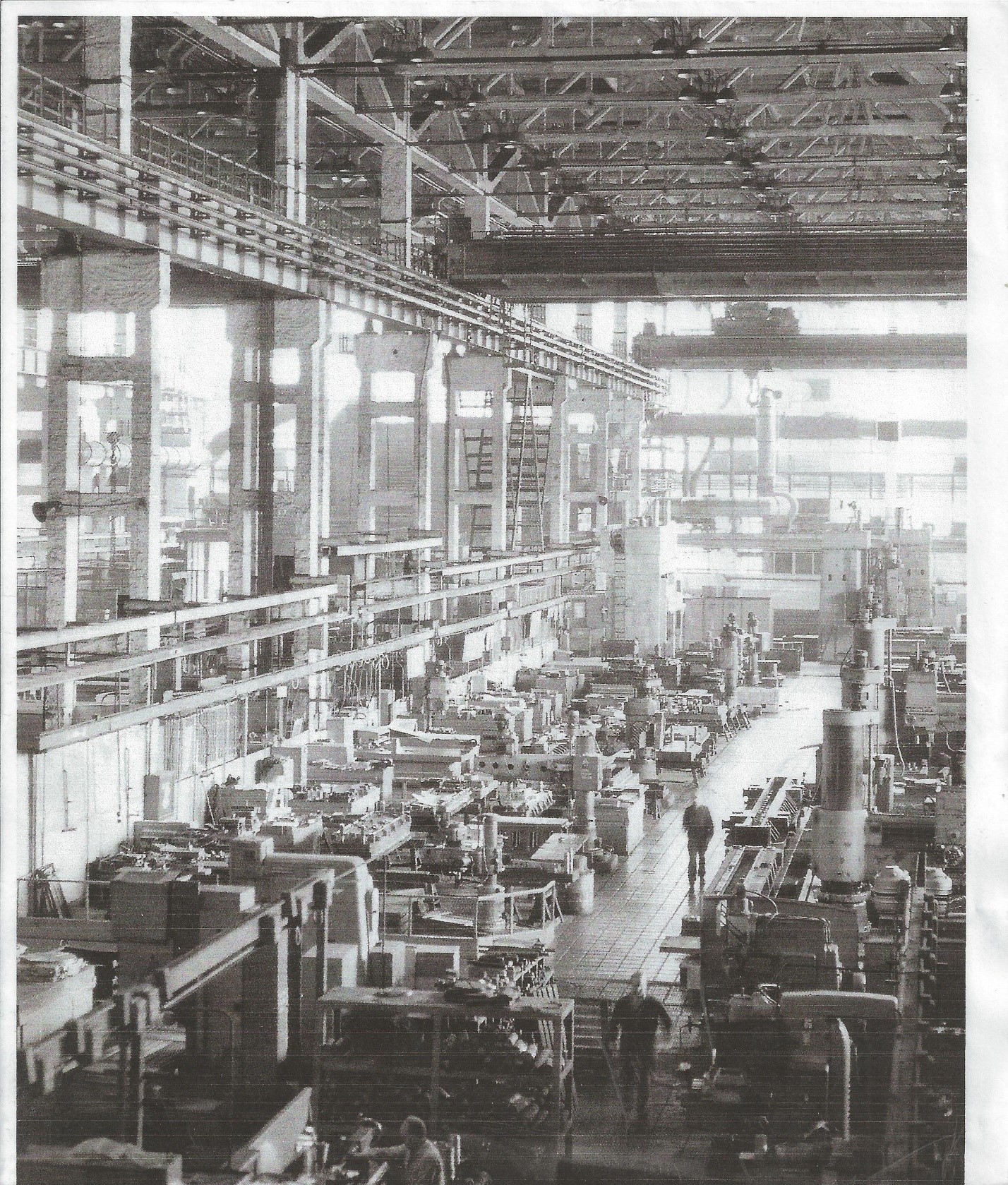
One of the bays of ZIL’s tool shop
(From the book “History of ZIL”)
