
Abelev's Discovery
Why I write about this
On January 10th, 2017 ( Abelev’s birthday) “Nezavisimaya Gazeta” published a photo of G. I. Abelev in the section “Names and Dates”. The caption under the photo said, “ Academician Garry Abelev (1928-2013) was a biochemist and a medical scientist; [note 1] he worked on the problems of immunology and, together with Yuri Tatarinov, discovered the reaction that bears their names. The reaction made is the basis of a test that can detect certain forms of cancer. As for his social position, Abelev was a diagnostician who spoke out against clerical obscurantism and the dominance of special services.”
This information is fake, apparently obtained from Wikipedia, which sometimes provides the authors of articles and essays with unverified information.
Abelev is known to the scientific world for his discovery of alpha-fetoprotein - protein in the blood serum of a developing human and mammalian embryo. Alpha-fetoprotein disappears almost completely from the blood shortly after birth, but reappears in adults suffering from liver cancer or some other types of cancer. This discovery played a significant role not only in creating a diagnosis test of liver cancer, hepatoblastoma and other tumors, but, also, and most importantly, in the development of a fundamental new cancer-embryonic theory of cancer – the discovery of the concept of a tumor and embryo similarity. The cancer-embryonic theory developed by Abelev, was accepted by the scientific community as a working hypothesis, which determined the direction of the scientific thought, and put Abelev immediately and forever among the great pioneers of science.
How it started
The discovery of alpha-fetoprotein is not a spontaneous epiphany of a genius. It took ten years of hard work by researchers at Abelev’s laboratory to solve the global scientific problem of finding antigenic differences between normal and tumor cells. Since the well-known studies conducted “according to protocols” did not give the expected results, the scientists found a new research method for the new work. It was based on the immunochemical method of immunodiffusion that appeared in the mid-50s, but now it was significantly refined and enriched. Abelev wrote, “We have mastered immunodiffusion to the basics, gotten used to it, introduced our own modifications, which were accepted both in our country and abroad. We have developed the so-called immunofiltration method, which allows detecting and isolating system-specific antigens, monitoring the dynamics of an individual antigen in a complex mixture with other proteins, and isolating it from this mixture.” Thanks to Abelev, the new results were analysed, clearly formulated and introduced into the logical framework of science.
In May 1962, L. A. Zilber and G. I. Abelev published the monograph “Virology and immunology of cancer”, which summarizes the research experience of the authors, as well as the experience of foreign researchers. For many years, this world’s first monograph used to be the reference book of immune-chemists and experimental oncologists [1]. In 1968, the second edition of the monograph was translated into English and published in England.
In July 1962, the VIII International Cancer Congress was held in Moscow, and Abelev made a report on alpha-fetoprotein there. Abelev’s colleagues from his scientific research group also made presentations at the congress. Information about the discovery of alpha-fetoprotein became widely known both from the report of the congress (1962), and from detailed publications in journals, such as, “Biochemistry” (February, 1963) and “Transplantation” (August, 1963). After Abelev’s report, a surge of applied research began in different countries of the world, where alpha-fetoprotein was of fundamental importance. For example, English researchers Brook & Suits developed a test to determine the pregnancy pathology. The discovery of alpha-fetoprotein gave a powerful impetus to the search for other embryonic antigens. Soon there was discovered the cancer-embryonic antigen (CEA) of colon and rectal tumors.
The following scientific discoveries are registered in the State Register of Discoveries of the USSR: “The phenomenon of embryo-specific protein synthesis by malignant tumors.”
Thesis: “There has been established a previously unknown phenomenon of synthesis and secretion in mammalian blood by emerging hepatocellular tumors and teratoblastomas with elements of embryonic cancer of alpha-fetoprotein, a specific protein in the blood serum of embryos.”
Authors:G. I. Abelev, S. D. Perova, and N. I. Khramkova (Kuprina).
Priority number and dates: No. 90 of May 25, 1962, January 30, 1963 and October 4, 1966[3].
Abelev combined his research work with teaching: from 1951, he taught at the Institute of Experimental Medicine of the USSR Academy of Medical Sciences. Starting from 1964, he was a professor at the Lomonosov Moscow State University, where he lectured at the Department of Biology. For 38 years he was delivering the course of lectures on immunochemistry which was the first course of its kind in our country. Starting from 1996, his lectures also covered molecular and cellular immunology.
Abelev has more than 300 publications that are part of the “Classics of Citation” (citation index more than 3000). He trained 22 candidates and 4 doctors of science. On December 23, 1987, Abelev was elected a member of the USSR Academy of Sciences in the Department of Biochemistry and Immunology. Since May 26, 2000, G. I. Abelev stayed an Academician of the Russian Academy of Sciences in the Department of Physical and Chemical Biology.
Yu. S. Tatarinov was introduced to Abelev by A. E. Gurvich, a friend and colleague of Abelev at the Gamalei Institute. Tatarinov was a part-time post-graduate student of Gurvich. Yuri Semyonovich Tatarinov (1928-2012) graduated from the Lunacharsky Astrakhan Medical Institute in 1952. In 1959, he became head of the Department of Biochemistry. Like many medical biochemists, he was a follower of S. Ya. Kaplinsky, who showed that the antigenic specificity of many serum proteins, including albumin, changes in liver diseases, and therefore, it is possible to create immunodiagnostics of various diseases on that basis.
Abelev wriote, “Tatarinov took our analysis system and our philosophy of immunodiffusion to heart.” In mid-1963, Abelev asked Tatarinov to test a person for alpha-fetoprotein in order to experimentally confirm the presence of alpha-fetoprotein in the blood of a person with liver cancer. (Indicated in the application for opening No. 90 with priority dated January 30, 1963) [3]. All the necessary information for testing was known. According to Abelev, Tatarinov, quickly tested two patients with liver cancer whose control tests showed complete absence of alpha-fetoprotein (control tests are necessary for the reliability of the obtained results) and was assured that an embryonic alpha-globulin was there. Tatarinov reported the test data at the 1st All-Union Medical Biological Congress in Moscow and published it in the journal (1964) [4]. Later, four more liver cancer patients were tested. Abelev considered the test results overestimated, although he paid tribute to the fact that Tatarinov was the first one to test for alpha-fetoprotein in a person with liver cancer. He wrote and spoke about this in his reports [5].
One can’t help but wonder why Abelev, understanding the practical significance of alpha-fetoprotein in testing a person for liver cancer, avoided this work and kept his employees away from it, despite the fact that his closest assistant, S. D. Perova, Candidate of Biological Sciences, had prepared the necessary serum for such a test. Abelev believed that the main goal of the work of the laboratory was to conduct fundamental research and obtain encyclopedic knowledge, which should be complete and applicable for those who could put it into practice. To achieve his goal and get a reliable scientific result, he sacrificed quick fame and commercial success, checking and rechecking the obtained results before transferring them to the clinic.
In 1965, I. I. Perevodchikova, Doctor of Medical Sciences, a chemotherapist from the Institute of Experimental Pathology and Therapy (IEPiTR), approached Abelev with a proposal to conduct a diagnostic evaluation of the alpha-fetoprotein test. Abelev referred her to Tatarinov, but she insisted on working together [5]. 28 blood samples were taken from patients with primary liver cancer. I. V. Assekritova, Perevodchikova’s post-graduate student, was involved in serum collection, Professor N. A. Kraevsky was responsible for pathologic diagnostics, and Perevodchikova conducted patient selection. Testing was performed by Phd S. D. Perova. in the laboratory of Abelev. It was found that alpha-fetoprotein appears in the blood not only in liver cancer, but also in teratoblastomas that occur at the embryonic level. The first results of this work were published along with Tatarinov’s data (1966).
Alpha Fetoprotein in Tumor Immunodiagnostics
In 1968, the World Health Organization (WHO) and the International Agency for Research on Cancer (IARC) decided to conduct a “blind” test of alpha-fetoprotein – as a marker of human liver cancer – in African countries where liver cancer was widespread at that time. This study made alpha-fetoprotein officially recognized as a marker of liver cancer.
Abelev was invited by WHO to take part in African research in order to establish scientific contacts and train employees of local laboratories, usually located in hospitals. WOZ sponsored the trip. Abelev suggested that Tatarinov should go with him, indicating that no extra expenses should be needed as the allocated funds would be enough for the 2 of them [5]. The WOZ administrators were not particularly enthusiastic about this proposal, but agreed to it, as they believed that while Abelev, a Jew not belonging to the Communist Party, would not be allowed to go on a long business trip abroad alone, all the obstacles would be removed if he was accompanied by Tatarinov, the rector of the Astrakhan Medical Institute and a member of the regional party committee.
In laboratories in Africa, Abelev gave lectures that he had prepared earlier for a trip to the United States. More than 700 people were tested in seven African countries. The tests were a huge success. Their results were transcribed in laboratories in the presence of the employees.
In 1970, at a conference in Lyon, the results of the African experiment were summed up and a decision was made: “Approve the clinical section of immunodiagnostics.” The AFP test became routine and was included into textbooks on oncology and tumors.
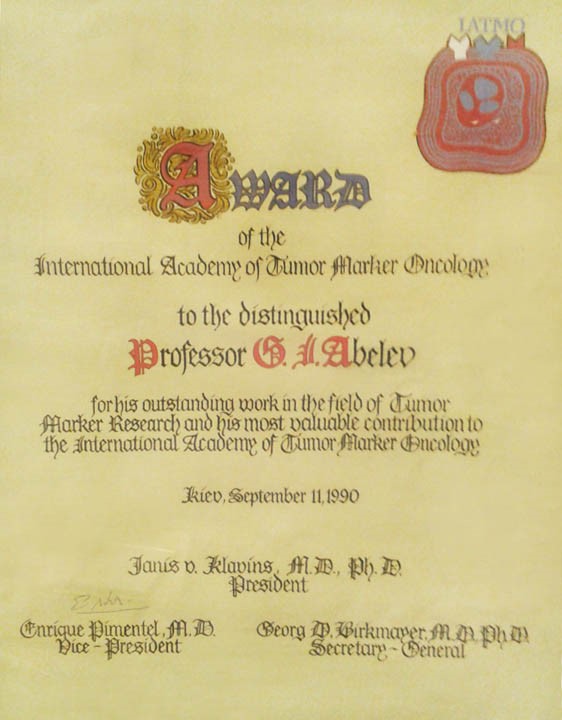
Award of the International Academy of Cancer of Tumor Markers to Professor G. I. Abelev for his most valuable contribution to the International Academy of Cancer of Tumor Markers. September 11, 1990 (Signed by the President, etc.)
In 1972, there was founded The International Group on Embryonic Proteins in Cancer, which in 1980, was transformed into the International Society of Cancer and Embryonic Biology and Medicine (ISCEBM), a great organization with its own journal, annual conferences in different countries of the world, and monographs including conference proceedings. ISCE/BM officially declares Abelev’s discovery of alpha-fetoprotein to be its start point.
International recognition
The discovery of alpha-fetoprotein has become one of the brightest events in the world of oncology. Abelev received the following rewards: the Gold Medal of the New York Institute for Cancer Research; the Distinguished Scientist Award of the International Group on Cancer and Embryonic Protein Research; the Medal of the Academy of Tumor Markers; the Abbot Prize of the International Society of Cancer and Embryonic Oncology and Medicine; he was elected an honorary member of the American Society of Immunologists and the European Association of Cancer Researchers; he became a Member of the Board of the International Society for Cancer and Embryonic Biology and Medicine; Chairman of the Expert Council on Theoretical and Experimental Oncology; WHO Expert on Immunology; a member of the Russian Supervisory Board of the International Science Foundation.
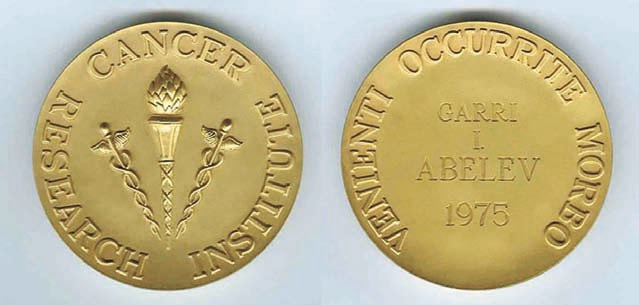
Photo of Abelev’s personalized gold medal (two-sided). Gold Medal of the New York Institute for Cancer Research-FirstInternational Prize in Cancer Immunology (1975)
Abelev was the winner of the USSR State Prize (1978), the Triumph Prize (2002) and the Vocation Prize (2004). He was also awarded the medal for Services to the Fatherland, II degree (2002) and got the title of Honored Scientist of the Russian Federation.
International recognition and fame did not make Abelev an inaccessible mentor in science. He remained a simple man, without the slightest sign of arrogance, while maintaining a democratic style of leadership in the Department. He always listened attentively to the opinions of his employees, regardless of their positions and titles. A.V. Gudkov, Abelev’s student and friend, recalled, "It was obvious how terribly awkward he felt as an examiner, as he did not recognize inequality in science and he always treated students as colleagues, i.e. with ‘respect. I don’t remember anyone getting anything less than an A from Abelev… " [7] [note 2]
On the other hand, Abelev was adamant when it was related to decency in science or personal relationship. This is what professor Yu. N. Solovyov, chief researcher of the Department of Pathological Anatomy of Human Tumors of the Research Institute of the Academy of Medical Sciences, who knew Abelev well (they met each other in 1943 as 7th-grade school students), was saying about him,
“He, who is sometimes such a gentle, and maybe even a little shy person, in reality is a firm and consistent man and scientist with very high principles, although his kindness can also be excessive.”
It can also be added that in everyday life, he was not a practical person. For a long time, he and his family lived in a communal apartment, then he bought a small cooperative apartment on the first floor of a multi-apartment building on the outskirts of Moscow and waited for more than two years for his turn to come to install the phone.
Americans call people like Abelev self-made. His parents had nothing to do with science: his father was a construction foreman; his mother was a typist. His brother, who was four years older than Abelev, died in 1943 on the Sinyavinsky Heights near Leningrad. After graduating from the Biology Department of the Lomonosov Moscow State University in 1950, Abelev was not offered any internship. With great difficulties, he got a job as a lab assistant in the biochemical department of the Gamaleya Institute of Epidemiology and Microbiology. Starting as a laboratory assistant, he became a senior laboratory assistant, and then – a junior researcher. Lev Aleksandrovich Zilber, the head of the department, an outstanding virologist and epidemiologist noticed Abelev’s knowledge and hard work. Thanks to Zilber, Abelev found his way in science and learned to overcome difficulties and injustice.
Zilber - A Man with a Heroic and Dramatic Fate
Lev Aleksandrovich Zilber (1894-1966) graduated from the Faculty of Physics and Mathematics of St. Petersburg University in 1915, and from the Medical Faculty of Moscow University in 1919. During the Civil War, he was a military doctor working at the front. After the war, he worked at the Moscow Institute of Microbiology. He suggested a new method of treating typhoid fever. In 1930, he led the suppression of the plague outbreak in Nagorno-Karabakh and developed a vaccine that proved to be more effective than all others, for that, he was presented to the Order of the Red Banner, but instead of getting the reward, was arrested on false charges. 4 months later, he was released at the request of M. Gorky. On his return to Moscow, Zilber organized a scientific virological laboratory and created a national school of virologists.
In the spring of 1937, an unknown form of encephalitis broke out in the Far East. The death rate among Red Army soldiers and the local population reached a high level. Zilber led an expedition to study the disease. Strains of the pathogen were isolated, the etymology and carriers of encephalitis were established, and the clinic of the disease was studied. All members of the expedition received the Stalin Prize - all of them… except for Zilber. He was arrested on an absurd charge - for trying to infect Moscow residents with encephalitis through a city water supply system.
At that time, the Prosecutor General of the USSR was A. Ya. Vyshinsky, an educated man who was well-versed in public speaking. He put into practice one of the ancient postulates: “the confession of the accused is the queen of evidence.” Zilber was charged under 7 clauses of article 58, each of which was punishable by execution. The NKVD issued a special directive allowing confessions to be extracted using “special methods of inquiry”, i.e. torture. The methods of torture depended on the investigator and the skills of his assistants. Zilber was subjected to conveyor-belt interrogation techniques, keeping him awake for three consecutive days and nights. They starved him, didn’t give him water. In the torture chamber of the Sukhanov prison, he was beaten on the floor, his kidneys were beaten off, his ribs and his left arm were broken… Despite the inhuman torture, Zilber did not incriminate anyone and did not sign the confession protocol. He was tried by the "troika " – a fast court, without witnesses and defense. Instead of receiving the capital punishment, he was “only” sentenced to 10 years. Zilber served his sentence in a Pecherlager at a logging camp, where after a year of working 10 – 12 hours a day, he almost died of hunger and cold. Pure chance helped him to survive. He assisted at the difficult delivery of the camp commander’s wife and was appointed a doctor in the prison infirmary. Prisoners in the camp died en masse from pellagra, a severe form of avitominosis. Zilber organized a small laboratory at the infirmary and managed to produce yeast rich in vitamins and amino acids based on yagel moss. He called the medicine Antipellargin. The Committee for Inventions and Discoveries issued an author’s certificate on Antipellargin addressed to the NKVD of the USSR. The camp doctor was soon taken to Moscow. Zilber was released in 1939 and became head of the Department of the Institute of Epidemiology and Microbiology, but was arrested again in 1940. This time, the authorities decided to use Zilber not at the sawmill, but in the chemical “sharashka” near Moscow, in the prison institute for special purposes. He was assigned to deal with bacteriological weapons. Zilber flatly refused. In the sharashka, he began studying cancer, and prisoners caught mice and rats for his experiments, and he paid them with tobacco. During a brief meeting with his ex-wife Z. V. Ermolyeva, who discovered Soviet penicillin, Zilber, despite the presence of security guards, managed to transmit his viral theory of cancer, written in microscopic handwriting on thin paper rolled up in the form of a button. The main idea of the theory is the following: “Tumors can be caused by viruses which, when entering the body, change the hereditary cell apparatus and, being in it, cause the transformation of a normal cell into a tumorous one. The very transformation of a normal into a tumorous cell is caused by the nucleic acid of the virus.”
N. N. Burdenko, chief surgeon of the USSR Army , L. A. Orbeli, vice-president of the USSR Academy of Sciences, V. A. Engelhardt ,academician, V. Kaverin, a famous writer, and Z. V. Ermolyeva sent a letter to Stalin about claiming the scientist’s innocence. On March 21, 1944, Zilber was released (There is also another version of the explanation for Zilber’s release ) On June 4, 1955, the Military Collegium of the Supreme Court of the USSR rehabilitated Zilber due to the lack of evidence of a crime. Since then, he was the permanent head of the Department of Virology and Immunology of Tumors which he founded at the Gamalei Institute.
In his essay on Zilber, Abelev wrote,
“Only two short periods of his life can be considered relatively normal - before 1917 and after 1954.” “Lev Alexandrovich’s department had an atmosphere of openness, creativity, and mutual respect. During 16 years of working with L. A., I never heard him being disrespectful to anyone, even to those who were half his age…His harshness and categoricalness had nothing to do with rudeness or humiliation. I’ve never heard him swear or flatter. There was some spiritual aristocracy in his nature, and we all respected that in him. He did not like those who " sew the last button to the finished uniform, and then claimed that the uniform had been sewn together.”
L. A. Zilber died from a heart attack while working in the laboratory.
Zilber wrote more than 250 scientific papers, including four monographs and two books. His works were translated into foreign languages. He was elected a full member of the Russian Academy of Medical Sciences, he headed the Cancer Virology Committee of the International Cancer Union, was an honorary member of the New York Cancer Academy, a member of the Royal Medical Society of England, and was awarded the Order of Lenin and the Red Banner of Labor. Zilber was awarded the Stalin Prize (1963) and the State Prize (posthumously) (1967).
Once in a conversation with me, Harry Izrailevich said, “Zilber admitted that once the virus enters the human organs, it can adapt and quickly multiply and cause not only cancer, but also other dangerous diseases to which a person has no immunity. He was sure that it is possible to create a vaccine against cancer and other diseases caused by the virus.” [note 3]
KGB and Abelev
In mid-1957, Abelev met with a representative of the KGB. “I was told that they really needed correct and completely objective information about Zilber and expected that I, as a capable and loyal student and employee of Zilber, would help them in this. They said that they knew that I had a small salary, lived with my family (two children) in a communal apartment with neighbors, and assured me that I could count on their support…”. Abelev flatly refused to cooperate, saying that he was not capable of such a task and that he had no information about Zilber beyond what everyone knew. Persuasions did not lead to anything [6].
After Zilber’s death, Abelev was appointed acting head of the department. The director of the Institute required all the heads of departments to join the communist party, and Abelev was not a communist. However, in the end, in 1969, Abelev was elected head of the department by competition. He kept the style of Zilber’s leadership and did everything possible to promote the development of fundamental scientific works and create a business atmosphere. All internal issues were resolved publicly. He encouraged employees and helped them with their publications. His name appeared in these publications only when he was directly involved in this work. The department took and fulfilled its “socialist obligations”, went out together to festive demonstrations, voted unanimously for the only candidate, went to collective farms to harvest potatoes in the field, sorted rotten vegetables at vegetable storages. There were no complaints about Abelev either from the party committee or from the trade union committee. But the KGB, as if leaving Abelev alone, did not forget about him.
In March 1971, Abelev was scheduled to fly to the United States for an international symposium on his cancer and embryonic theory, where he had an opening lecture. Two days before departure, he saw a black Volga waiting for him at the entrance to the Kievskaya metro station, which took him to the building of a dilapidated church. Abelev recalled: “Inside the church, there were several good rooms with good furniture. The young people who were there, were polite, but they didn’t stand out in any way. I was being interviewed by a nice elderly man sitting at a massive desk. He said that he understood the importance of the work we were doing. He explained to me how difficult it was for them to navigate international contacts and distinguish real scientists from sent agents. Also, he said that they were not be able to do without the help of scientists themselves, and that I, as a Soviet citizen, must help them in this. He said that my name would not be mentioned anywhere, he also spoke about meeting points and passwords. He reminded me that they are a powerful organization, and that coordinating promotion to the Academy of Sciences, travel abroad, and nomination to high positions and awards.” Abelev flatly refused to cooperate. The conversation which lasted over three hours, did not lead to anything, and he did not fly to the United States [6]. Nelson Rockefeller, the US Vice-President applied to the Soviet authorities through A. F. Dobrynin, the USSR Ambassador in the United States, with the request to allow Abelev to come to the conference in the United States, but even that did not help. Abelev became “banned from traveling” for twenty long years. On behalf of Abelev, the Institute’s administrators sent polite RSVP to the invitations from abroad thanking the hosts and informing them that he would not be able to come. The letters from abroad either were not delivered to him at all, or were delivered in the opened envelopes… Visits of foreign scientists to laboratories were limited to a minimum and were allowed only in the presence of “outsiders”. Abelev was not only banned from traveling, but also became “unwelcome” in his country. His candidacy for a corresponding member of the AMN was withdrawn. [6]
On November 10, 1971, Abelev was invited to see the director of the Institute to hear the order to liquidate his department. All 50 people, including Abelev, were dismissed and had to re-apply for a job at the competition. Abelev was temporarily left acting head of the laboratories of immunology and tumor diagnostics. The atmosphere in the laboratories was extremely tense. On December 3, Abelev submitted his resignation letter. Abelev could apply to work at the Moscow State University. In 1965, I. G. Petrovsky, rector of the Moscow State University, suggested that he should head the Department of Virology. Besides, he could emigrate. Universities in America, Europe, and Israel would certainly give him a decent professorship. However, Abelev did not bear the thought of being left without his laboratory, parting with the employees closely connected with his past work and plans for the future. The only way out of this situation, he saw in the transfer of his department to the oncology center of N. N. Blokhin. The laboratory staff also supported this idea. This transfer could be possible only at approval of the Presidium of the Academy of Medical Sciences, to which the Gamaleya Institute was subordinate.
The deadline for submitting documents for the competition expired on December 23. However, no one applied for the competition. The Presidium of the Academy received letters from various organizations about the inadmissibility of ruining one of the best laboratories in Moscow dealing with the problems of tumor immunology. Well-known scientists applied to V. D. Timakov, the President of the Academy, in support of Abelev. Blokhin was ready to take Abelev’s laboratory, but he wanted the transfer to be carried out on the initiative of the Academy, so that it could be possible to insist on the transfer of equipment and on allocation of additional funds. Abelev conducted endless telephone conversations from a frozen pay phone, since the phone booth was located not far from the house. In extreme cases, he used the phone at the place of the neighbors whom he met when moving to a new home. The neighbors were nice with the professor. Abelev was extremely nervous – he was suffering from insomnia and headaches, and his face took on an earthy tone. It hurt to look at him.
At this time, Abelev received an invitation from the Committee for Inventions and Discoveries to receive diplomas for scientific discovery No. 90. This invitation also included Yu. S. Tatarinov and employees of the IEPiTR Institute: I. I. Perevodchikova, N. A. Kraevsky, I. A. Assekritova, who transferred materials to the Abelev laboratory for the diagnostic alpha-fetoprotein test evaluation. It is unlikely that their work, as well as Tatarinov’s test, could be recognized as scientific discoveries. But it was another matter when they were connected to the discovery of alpha-fetoprotein!
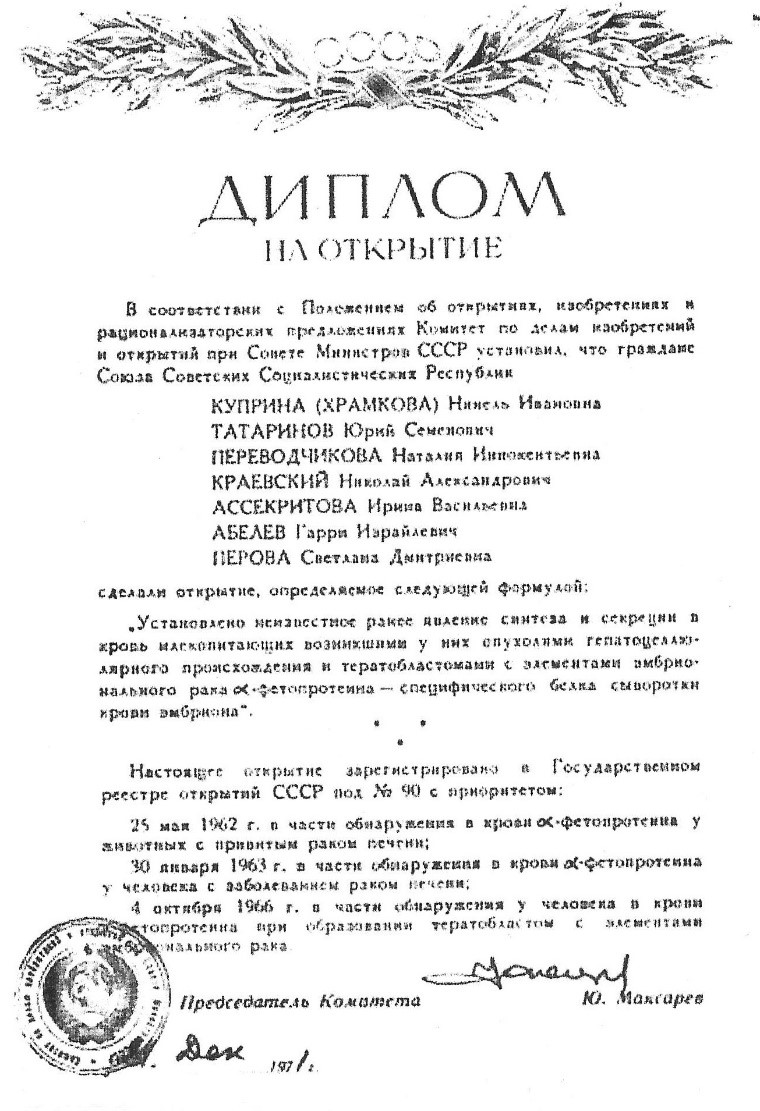
Photo of the Discovery Diploma
The idea of combining the works into one discovery did not appeal to Abelev, but at the persistent insistence of Gurvich, he agreed, but insisted that the -however, insisted that the priorities should be clearly delineated:
- May 25, 1962 - detection of alpha-fetoprotein in the blood of animals with liver cancer
- January 30, 1963 - detection of alpha-fetoprotein in the blood of people with liver cancer
- October 4, 1966 - the detection of alpha-fetoprotein in human blood during the formation of teratoblastoma.
The Discovery Regulations state: “An application for a discovery diploma must relate to only one discovery.” “The priority of a discovery is determined by the date when the discovery statement was announced, or by the date when the specified provision was published in the press, or by the date when it was otherwise brought to the attention of third parties” (for example, a conference report).
When specifying priorities, Abelev did not link them to specific performers and the dates of completion and publication, as he believed that the priority could be clearly seen through comparison of the work of additionally included co-authors with the work required for discovery No. 90. Indeed, “according to the Hamburg account” this was true, but only specialists know about it.
In the State Register of Scientific Discoveries of the USSR, discovery No. 90 contains original title, formula, and priorities, and the names of the authors are the following: G. I. Abelev, S. D. Perova, and N. I. Khramkova (Kuprina).
The works of additionally included co-authors are presented in the attached “Description of the discovery” in a free verbose presentation (not in formal language), without specifying exact dates and including advertising supported by patriotism [3].
I asked Abelev why his name was listed in the diploma as the penultimate one. Usually, the names are arranged in alphabetical order or in order of the value of the contribution made. “I am thankful that they did not delete my name at all,” Harry Izrailevich replied.
The meeting of the Presidium of the AMS was scheduled for December 22, 1971 at 2 pm. Coincidentally, at 10 a.m. on the same day, the Committee for Inventions and Discoveries was to hold an Award Ceremony. Tatarinov picked up Abelev on his way to the Academy, while Perova and Khramkova refused to go for their diplomas.
Abelev believed that after the diploma presentation, Tatarinov, who was aware of the events that were taking place, would go with him to the meeting of the Academy to support him. As rector of the Medical Institute, he was familiar with both the Minister of Health and the President of the Academy of Medical Sciences. Tatarinov did not attend the Academy meeting. In early 1972, Yu. S. Tatarinov was transferred to Moscow as Vice-rector for Science of the 2nd Pirogov Moscow Medical Institute (MOLTMI), where he headed the Department and Laboratory of Biochemistry. Soon, he brought talented young scientists who had been working in the biochemistry laboratory he headed at the Ufa Medical Institute, to his laboratory in Moscow.
At the Presidium session, the transfer of Abelev’s department to the Cancer Center was not approved. Instead, a decision was made to restore the Department at the Gamalei Institute with guarantees that none of the employees would be harmed.
The staff was not very enthusiastic about the restoration of the Department at the Institute. When Tatarinov came to the laboratory to learn about the Academy’s decision, he got a cold reception. On the same day, “in view of the decision of the AMS Presidium to restore the department,” Abelev wrote a statement asking to consider the application submitted earlier invalid. Abelev felt almost like a traitor, but he could not leave the laboratory with which his whole life was connected. Seeing him in a difficult state of mind, his colleagues purchased vouchers to a holiday home near Moscow for Abelev and his wife.
Fundamental science is inherently global. It requires meetings with world scientists, publications in international journals, and international verification of the results of serious work. Abelev was deprived of all this. He could not even receive foreign journals, because they were sent, bypassing libraries, to special storage facilities. But the attention of the scientific community to the isolation of Abelev and his colleagues increased. In May 1977, after a visit of an official American delegation to the Oncology department and another scandal, the President of the Academy of Medical Sciences issued an order and the Department was transferred to the Cancer Research Center which was under construction. Just in 3 days, the laboratories with all the equipment and animals were moved to a new place.
I must say that neither Abelev’s academic nor administrative career corresponded to his scientific level and world fame. Nor did he aspire to a high position. He invested his authority and knowledge in the laboratory, in his students at the MSU biology faculty, and in his dedication to fundamental science, not as a manager, but as a creator working on the edge of the known and unknown. Abelev wrote about the period from 1972 to 1977: “we worked hard – and not just hard, but greedily, and I think we did a number of important things.”
But the clouds over Abelev continued to thicken. A political case was initiated against him, which could cause his arrest. He learned about that from Timakov, President of the AMS. The accusation was that he allegedly applied to the Supreme Soviet of the USSR with a letter about the transfer of the Crimea to the Jews. The case was organized by the KGB and brought to the attention of only the Minister of Health and the President of the Academy of Medical Sciences. Timakov, when meeting Abelev, said that he checked the accusation through his own channels and was convinced of its absurdity, but everything depended on the KGB’s decision. The sword of Damocles hovered over Abelev.
The next day, Abelev asked me to stop by his house. He gave me 17 volumes of the Jewish Encyclopedia in Russian, published in 1905. I didn’t ask for the reason of this act. Before I left, Abelev’s wife said: “If they inquire, say that you asked for the books yourself.” The encyclopedia contained information about famous rabbis, Jewish writers, artists, composers, scientists, financiers, statesmen, military leaders, and other historical figures.
Abelev was not an outspoken dissident, nor did he oppose the special services. Even in the most difficult time for him, he did not allow the thought of emigrating. At the same time, he could not be forced or bribed to become an informant. By refusing to cooperate with the KGB, Abelev sacrificed his personal interests, but retained his moral and ethical values, as well as his inner freedom. If Zilber were still alive, he wouldn’t be ashamed to look his teacher in the eye.
E. A. Abeleva
Elfrida Adolfovna Abeleva (nee Elfrida-Leokadia Adolfovna Zibart) (1923-1996), Abelev’s wife, shared all the difficulties of his life. She graduated from the Moscow State University with a degree in genetics. After graduation, she stayed to work at the faculty of MSU. But there began persecution of genetics. This is what Professor Prezent Isai Izrailevich, an ideologist of academician-agronomist Lysenko, wrote in a memo to V. M. Molotov, the Chairman of the Council of People’s Commissars of the USSR: “Our Morganist geneticists have recently begun to sing along to the chorus of capitalist mutts in genetics. Academician Vavilov in a number of public speeches declares that we will go to the stake, portraying the case as if the times of Galileo were revived in our country (in four years Vavilov will die of starvation in a prison cell-S. Gorfinkel). The behavior of Vavilov and his group has recently been intolerant, and they intend to use the international Genetic congress to strengthen their position and status.” Genetics and cybernetics in the USSR were declared bourgeois pseudo-sciences that did not correspond to socialist materialism. In the philosophical dictionary of genetics, it was said: "Michurinsky biology rejects the chromosomal theory of the Weismannists-Morganists with its mythical genes, as a reactionary fiction " [примечание 4]
All work in the field of genetics was stopped. Professors were expelled from universities. Textbooks for schools and universities were rewritten. Scientists working in the forbidden fields of cybernetics and genetics were accused of deviating from “ideologically correct theories” and of being cosmopolitan. Abeleva was also fired from the university. Her situation was worsened by the fact that she was the daughter of an “enemy of the people.” Her father, Adolf Augustovich Zibart, was rector of the Bauman Moscow State Technical University (then director of the MMMI), the largest technical university in the country. It was under his leadership that the engineering education was significantly improved. In December 1937, A. A. Zibart was arrested. He was not released after serving his term of sentence, and his letters from the Magadan Correction Labor Camp stopped arriving in 1946. The date of death and the place of burial are unknown. He was rehabilitated in 1957. His family (his wife, mother-in-law, two daughters and his wife’s nephew) became victims of scammers who deprived them of their apartment, property and valuable library. They received a room in an old wooden barrack and, surprisingly, were not deprived of a country house (“ dacha”) in Malakhovka, a small town near Moscow. Abeleva worked as a laboratory assistant in various medical institutions for 7 years. And only in 1955 she was able to return to her specialty and defend a thesis. As a senior researcher at the N. K. Koltsov Institute of Developmental Biology, she devoted herself entirely to her work. Elfrida Adolfovna Abeleva was awarded the Order of the Badge of Honor [8] for the development and restoration of genetic science in the USSR.
Among friends, Elya (as her family and friends called her) was an interesting companion, the soul of society. Being an exceptionally decent person, she was sensitive to injustice. Thoughts on the connection of ethics with science and life are expressed in the article by E. Abeleva and G. Abelev "Ethics is the cement of science "(journal “Chemistry and Life” No. 2, 1996).
Letter of Academicians to President V. Putin
In 2007, Abelev was among 10 academicians of the Russian Academy of Sciences, including the two Nobel Prize winners, signed a letter to President Putin: “The Policy of the Russian Orthodox Church: Consolidation or Collapse of the Country?”. The letter expressed concern about the penetration of Church into all spheres of public life. In particular, the focus was made on the recent proposal to include specialty “Theology” into the list of scientific specialties, as well as on adding “Fundamentals of Orthodox Culture” as a compulsory subject in the curriculum of all Russian schools. It was said that while it was called a cultural subject, in fact, it meant the introduction of the subject “The Law of God” into school program on basis of the federal educational standards. Academicians wrote: “Any scientific discipline operates with facts, logic, evidence, and not faith.” Violation of the constitution in a multi-religious country may lead to religious conflicts. Academicians suggested introducing the textbook “History of World Religions” in grades 10-11 of secondary school, but the Orthodox Church strongly opposed to that proposal. The letter ended with the words: “To believe or not to believe in God is a matter of conscience and conviction of each individual. We respect the feelings of believers and do not aim to fight against religion. However, we cannot remain indifferent when attempts are made to question scientific Knowledge…”
Abelev in Wikipedia Articles
“Wikipedia cannot guarantee in any way the correctness of the data provided in it.” [note 5] The accuracy of the information depends on the qualifications and integrity of the author. It is not uncommon for unscrupulous authors to provide fake information on Wikipedia based on their personal interests. If this information is used, for example, in an article by another author, then when the referral is made to such an article, you can assume that the false information provided in Wikipedia has been “laundered”.
In recent years, Wikipedia articles have been persistently giving the credit for the discovery of alpha-fetoprotein mainly to Tatarinov. For example, the article “Yu. S. Tatarinov” says: “In 1963, Professor Yu. S. Tatarinov (Astrakhan Medical Institute) discovered the presence of alpha-fetoprotein in the blood of people suffering from primary liver cancer.” "Biochemist Yu. S. Tatarinov had been studying antigens in human fetal serum for a long time. By applying complex biochemical and electrochemical techniques, he was able to isolate three specific antigenic components that differ in their mobility in the electric field. In the laboratory of another immunologist, G. I. Abelev, it was found that one of the components isolated from serum (ZB – glycoprotein) is identical to the lipoprotein that was previously detected by Yu.S. Tatarinov in the blood of patients with liver cancer. The combined efforts of both laboratories proved that it is absent in the serum of healthy adults, but it occurs with great regularity in the serum of patients with a certain form (the so-called hepatocellular) of liver cancer. The reaction of G. A. Abelev and Yu. S. Tatarinov has been tested both in our country and, by the decision of the World Health Organization, in some African countries. The test results indicate that the test is highly reliable. This discovery of Soviet scientists is not only of practical significance… "(further on - all in the spirit of patriotism). “For research on the properties of human reproductive system tissues… Yu. S. Tatarinov was elected an Academician of the Russian Academy of Natural Sciences.” [note 6]
In another article, called “Alpha-Fetoprotein”, nothing at all is said about Abelev’s discovery of alpha-fetoprotein. Abelev’s name is mentioned only in the link “Tatarinov – Abelev test”.
Professor Yuri Semyonovich Tatarinov (1918-2012) was Honored Scientist of Russia, Laureate of the USSR State Prize (nominated together with Abelev), laureate of the Vocation Prize [note 7] (nominated together with Abelev), an excellent teacher and a capable organizer. He prepared 6 candidates of sciences. During his student years, he was an active Komsomol member, for 6 years, he stayed chairman of the trade union committee of the Institute and editor of the institute newspaper. In 1966-1971 he was Rector of the Astrakhan Medical Institute. Since 1972, he was the Vice-rector for Science at MOLTMI. His colleagues remember him as an honest and sympathetic person.
I am sure that if Yu. S. Tatarinov were still alive, he would not approve of Wikipedia articles that belittle Abelev’s achievements recognized by the scientific world.
One can’t help but wonder why Yu. S. Tatarinov, who has repeatedly traveled abroad to participate in scientific conferences, being a member of the editorial board of the reputable international journal “Tumor Biology”, is not mentioned by foreign experts as a scientist who made a major discovery in biology.
I asked Abelev this question. As I remember, he replied, as follows: after my announcement of the discovery of alpha-protein at an international conference in 1962 and the earlier publication of the monograph describing methods of immunodiagnostics, there began numerous studies in the field of cancer testing all over the world. Tatarinov’s work was evaluated as an ordinary laboratory work of the usual level. Moreover, he did it in a hurry, without the control tests usual in such cases.
The Documentary “Abelev’s Discovery”
On January 10, 2008, the Cancer Center of Moscow hosted a conference dedicated to the 80th anniversary of G. I. Abelev , Academician of the Russian Academy of Sciences. On the same day, the national TV channel Kultura broadcast the documentary film “Abelev’s Discovery” (Russia, 2004; written and directed by Oleg Markov; cinematographer Vladimir Rostkov).
In the film, leading experts in medicine and biology, who are at the forefront of science, talk about Abelev and his discovery made more than 45 years ago.
A. I. Vorobyov, Academician of the Russian Academy of Sciences; Director of the Hematology Research Center of Russia:
“Abelev has made a world discovery – the first cancer protein. No doubt, this is a fundamental work, which has led to a lot of other works on cancer proteins.”
M. I. Davydov, Academician of the Russian Academy of Sciences, Director of the N. N. Blokhin Russian Cancer Research Center:
“The discovery that he made -alpha-fetoprotein- is of global significance and, in fact, it saved hundreds of thousands of people from inevitable death. It certainly deserves the Nobel Prize. And only by a misunderstanding, he did not receive this Nobel Prize.”
George Klein, a member of the Nobel Committee, Professor at the Karolinska Institute (Stockholm):
“Now we know more examples from this field, but Abelev was a pioneer and for this he received world recognition.”
S. E. Shnol, Professor, Head of the MSU Physical Biochemistry Laboratory:
“Abelev’s book” Virology and Immunology of Cancer " provides a detailed description of the experiments and research methods that made it possible to enter molecular biology for the first time in the world."
The last years of his life, Abelev was ill and was in the shadows, and gradually people began to forget him. But he won’t be forgotten. The memory of Abelev will live not only in the hearts of his students, colleagues and people who knew him, but also it will remain in the History of Science as memory of a scientist who made a discovery of world significance.
Solomon Gorfinkel
August 2017
Notes:
- Abelev was not a medical scientist.
- Andrey Vladimirovich Gudkov, PhD in Biology, Professor of Oncology, Senior Vice-President for Basic Science and Head of the Department. Department of Cell Stress Biology of the Institute of Oncology. Roswell Park, Buffalo, New York (USA).
- In December 2008, scientists Harald Zurhazen (Germany) and Oliver Smiches (England) were awarded the 2008 Nobel Prize in Physiology or Medicine for their work showing that the human papillomavirus causes cervical cancer in women, and for inventing the first mass-produced cancer vaccine in history.
- Short philosophical dictionary. Edited by M. Rosenbaum and P. Yudin. State Publishing House polit. literatures. Edition 4. 1945 It has a circulation of 1.5 million copies.
- Wikipedia: “Disclaimer”.
- Russian Academy of Natural Sciences – a public organization that does not require election to join.
- For the contribution to the development of medicine made by representatives of basic science and non-medical professions.
References:
- Zilber L. A., Abelev G. I. Virology and Immunology of Cancer, Moscow, Medgiz, 1962, p. 485
- Zilber L. A., Abelev G. I. The Virology and Immunology of Cancer. Oxford, Pergamon press, 1968.p. 418.
- Scientific discoveries of Russia. State Register of Discoveries of the USSR.
- Tatarinov Yu. S. Journal " On Medical Chemistry". 1964 Vol.Kh. #1, pp. 90-91.
Literature:
- Abelev G. I. Alpha-fetoprotein in tumor immunodiagnostics.
- VIVOS VOCO. G. I. Abelev: A story about how he was recruited to the KGB, and about the dramatic pages of history …
- Gudkov A.V. The Living Part of Fate. In memory of G. I. Abelev. Troitsky variant – “Nauka”, January 14, 2014 , No. 145, p. 4, “Memory”.
- In memory of E. A. Abeleva. ONTOGENY, 1996. vol. 27, no. 4, pp. 317-318. 9 .Kiselev L. L., Abelev G. I. Zilber L. A. [In Russian]. https://vivos-voco.astronaut.ru
- Abelev G. I. Ocherki nauchnoi zhizni [Essays on Scientific Life], Moscow: Nauchny Mir Publ., 2006, p. 498 p. (See on the website)
- Photo (portrait of G. I. Abelev) from the book: “G. I. Abelev. 50 Years in Tumor Immunochemistry”, Moscow, Russian Cancer Research Center named after Blokhin, Russian Academy of Medical Sciences, 2001, p.196
Feedback:
A. V. Gudkov
Dear Solomon,
I finally read your article “Abelev’s Discovery” and wanted to write to you about my impressions.
First, and most importantly, I am very grateful to you for taking on the task that Abelev’s students should have done, the task of cleaning up the truth from distortions and lies – to return what was stolen to its place. Not being an expert, you were able to clearly and accurately explain the essence and importance of Abelev’s discovery. I admire your laconic syllable, concentration of thought and the breadth of information coverage. I realize how difficult it was to be able to convey so much in a short text. Thank you!.. Once again – thank you for your work. Your article is beautiful in form and, indeed, extremely necessary
With great respect and admiration, your Andrey Gudkov
Andrey Vladimirovich Gudkov, PhD in Biology, Professor of Oncology, Senior Vice-President for Basic Science and Head of the Department. Department of Cell Stress Biology of the Institute of Oncology. Roswell Park, Buffalo, New York (USA).
M. A. Yudkevich
Hello, Dear Solomon Izrailevich!
It was with great pleasure that I read your article about the scientific activity and the fate of an outstanding person. Although I have never had anything to do with the topic of G. I. Abelev’s research in any way, it was thanks to your article that I got the opportunity to assess the significance and scale of his work and the personality… And as for the reviews, you can’t say better than
A.V. Gudkov, so we will completely agree with him.
Mark Adolfovich Yudkevich, Candidate of Technical Sciences.
